Showing posts with label blimp. Show all posts

Thursday, March 5, 2015

Volunteer at Rest

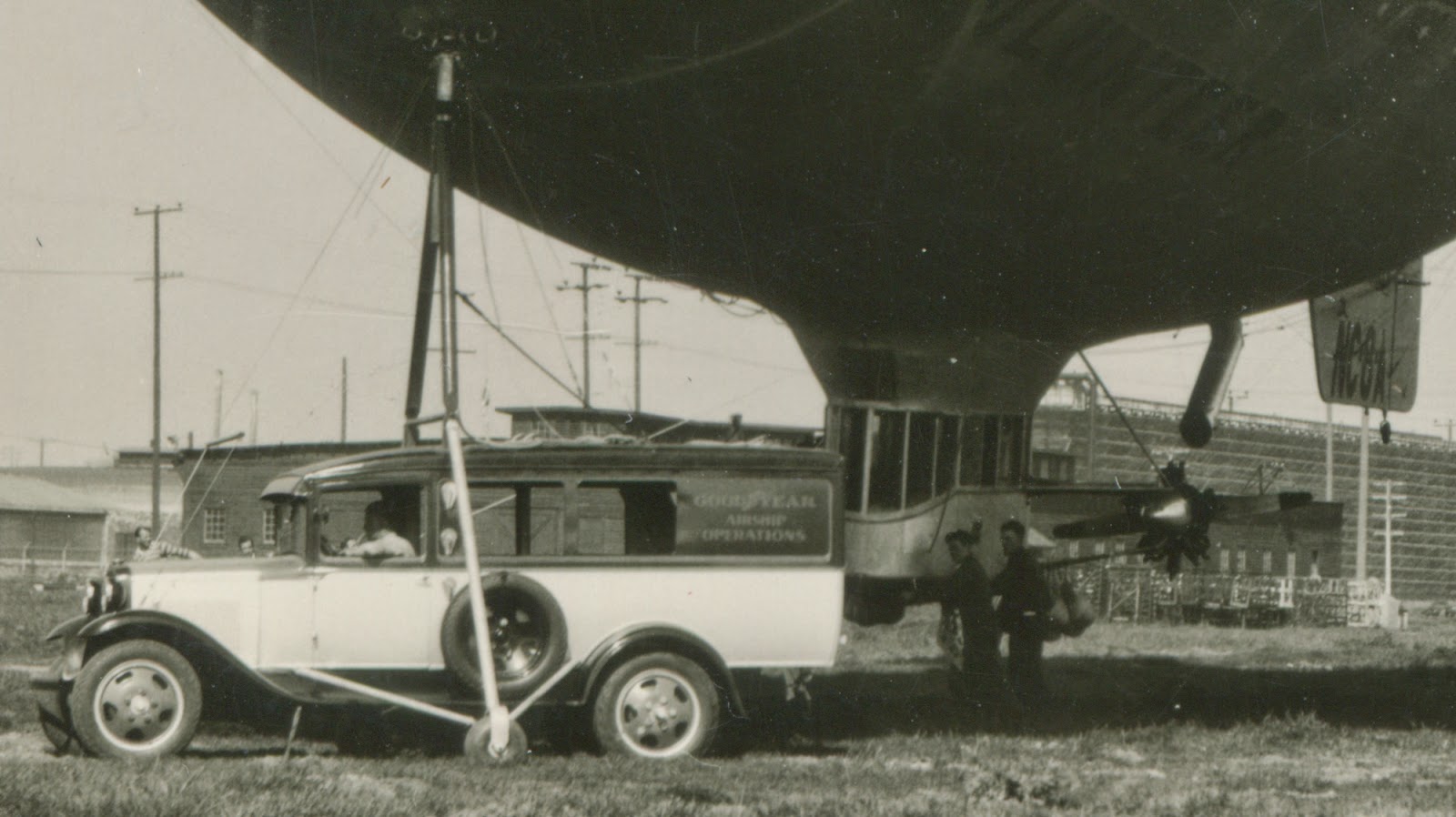
Here are three more photos from our small collection that came from the San Francisco UPI office when it closed in the late 1960s. The date is probably 1931 or 1932, the location is a Goodyear plant, probably in Southern California. The airship is the Volunteer, the same blimp featured in last week's photo.

The Volunteer was Goodyear’s second Type TZ airship, and fourth overall (after Pilgrim I and II, and the Puritan). Goodyear’s president, Paul Litchfield, had a penchant for naming the airships after America’s Cup yachts, seeing the blimps as yachts of the sky.

These three photos also feature Goodyear's west coast portable mooring mast, a 1930 Ford Model AA, the truck version of the Model A passenger car. It was fitted with a collapsable mooring mast and outriggers to keep it from tipping. The mast included a pivot which allowed the airship to weathervane. A Buick bus performed similar duties for Goodyear's east-coast airship. Now that Goodyear is transitioning from blimps to Zeppelins, they have selected a massive Mack truck to serve the same purpose in 21st Century.

The Volunteer series airships were the west-coast Goodyear advertising representatives. The first one first flew on April 27, 1929, and sported a 128-foot long, 36-foot diameter envelope which held up to 86,000 cubic feet of helium.

The Volunteer I was retired in late 1929, when Goodyear decided to replace the envelope with a larger, 96,000 cu. ft. one (it was 133 feet long with a 39 foot diameter), and the original 82hp Siemens-Halska engines were replaced with 110-hp Warner Scarabs. The “new” Volunteer retained the original car, and the original NC-8A registration number.

The II only lasted for two years (so, if my math is right, the II is the airship shown in our three photos), because Goodyear decided once again to expand the size of the envelope, installing 112,000 cu-ft bags. Ultimatey, there were three iterations of the Volunteer with this configuration, III, IV and V. In each case, the car and the registration were reused.

Odd little trivia twist: the Volunteer (the airship) was named after the Volunteer (the yacht) which was built in 1887 and successfully defended the America's Cup against the Scottish challenger Thistle that same year. The Volunteer, along with the two previous America's Cup yachts Puritan (1885) and Mayflower (1886) (which also had blimps named after them), was designed by Boston maritime architect Edward Burgess, the father of W. Starling Burgess who started the Burgess Company, the largest manufacturer of license-built Wright Brothers aircraft, until he sold out to Glenn Curtiss in 1916.


Thursday, February 26, 2015

A Busy Day at Glendale

For a few magical years before World War II, Glendale's Grand Central Air Terminal was the hub of the aviation scene in Southern California, and so there was always something going on. On this day, probably sometime in 1932 or 1933, Goodyear's Type TZ airship Volunteer descends steeply for a landing while T&WA's Fokker F-32 NC-333N taxis up to the terminal. Just another day at Glendale....


The Volunteer (and the registration NC-8A) was actually a series of airships that all utilized the same gondola or "car", but which were equipped with progressively larger envelopes. Our photo most likely shows the Volunteer III, which first flew on September 5, 1931.


Also visible in the photo is Roscoe Turner's Gilmore Oil Lockheed Air Express (NR3057), a parasol-wing variant of the venerable Vega, and just beyond it, the window line of a Lockheed Orion, probably one of Varney Air's Northrop Delta (several folks, including Tim Kalina and John Underwood, wrote to correct me on this one!).


Although Volunteer wasn't based at Glendale, she was a frequent visitor. The photo below comes from the Archive's R.C. Talbott negative collection and features California Governor James Rolph getting a ride on the Volunteer; there's no way to tell whether this was on the same day as the photo above, or another visit by the airship.


Glendale had its own "pet" dirigible, the City of Glendale developed by Slate Aircraft (see our post from August 20, 2013, for a history of this ill-fated project). In the overhead photo below, the City of Glendale pokes its nose out from its hangar. Both photos in today's post come from a small collection that was saved from UPI's San Francisco bureau office just before the vast bulk of their old photo archive was discarded after the office closed.


In the view below, from Google Earth, I've tried to get the same approximate angle as in the one above.

Thursday, January 8, 2015

Plane vs. Balloon

In honor of the Centennial of World War I, Vintage Air will be posting a series of images from that conflict over the next few years. The article below was our inaugural post when the blog first started, and now has been updated with an additional recently-acquired image.

This image is from a stereopticon card that was published sometime late in World War I, and shows a scene of aerial combat between an American biplane and a German observation balloon. The back of the card describes the scene in rather sensationalistic terms:

"Far above the surface of the earth you can see one of the battles of the air, with the American aviator in his 'plane victorious over the German observation balloon. Swinging in the tiny wicker basket which to you seems just a dot beneath the balloon, a German officer has been watching the least little movement behind the lines of the American troops.

"It was to defeat his purpose that the American in his 'plane ventured over the lines and gave battle. Swooping swiftly, curving and diving to avoid the hail of machine gun bullets and high explosive shells with which the Germans sought to bar his path, he reached his goal and with incendiary bullets struck at the hugh [sic] gas bag.

"One of his bullets has penetrated it, less than a minute ago, for within a few seconds the balloon will be entirely consumed with the flames, an the observer will have attempted to save his life by jumping with his parachute. In the length of time that it takes you to look at the balloon with its finlike projections at the stern to add to its stability, the highly inflammable gas will have burned and the few bits of charred wreckage dropped to the earth.

"His work done, the aviator is turning to journey back toward his own lines, three or four miles over enemy territory, to report: 'One "blimp" shot down.'"

I find it interesting how the text shortened the then-popular aeroplane to just 'plane, complete with apostrophe. The balloon's design itself shows that this image was taken sometime after 1916. The Germans' own design for an observation balloon (Parseval-Siegsfeld, nicknamed the "sausage"), was deemed inferior to the Allies', so when the Germans were able to capture a French Caquot balloon (which itself was based on an English design), they reverse-engineered it and immediately put it into production, designating it the Ae800, or Achthundert English 800. Unlike their own design, the Ae800 could be lofted to 5,000 feet above the ground, in winds up to 44 mph.

Because of the vulnerability of the Ae800 to attack from Allied aircraft, the balloons were attached by cable to engine-driven winches which could pull a balloon down from 1,000 feet in under a minute. In addition, the Germans usually surrounded their balloons with a ring of anti-aircraft machine guns and artillery Because of these measures, Allied pilots usually only went after balloons when they were above 1,000' AGL.

As mentioned in the text, the observer likely had a parachute on, as these officers were the only ones that were routinely issued such safety gear. Unfortunately, the parachute technology was rather immature, and they had a rather high failure rate, so they were used in only the most dire circumstance.

The second photo (right) has the following hand-written on the back: "A balloon shot down and falling. Observation balloon wich [sic] are roped to the ground." Although it's hard to tell because of the amount of destruction to the envelope, this one appears to be one of the earlier British balloons. Presumably, since the basket appears to be empty, the observer has already jumped.


Friday, September 30, 2011

Just Another Goodyear Blimp

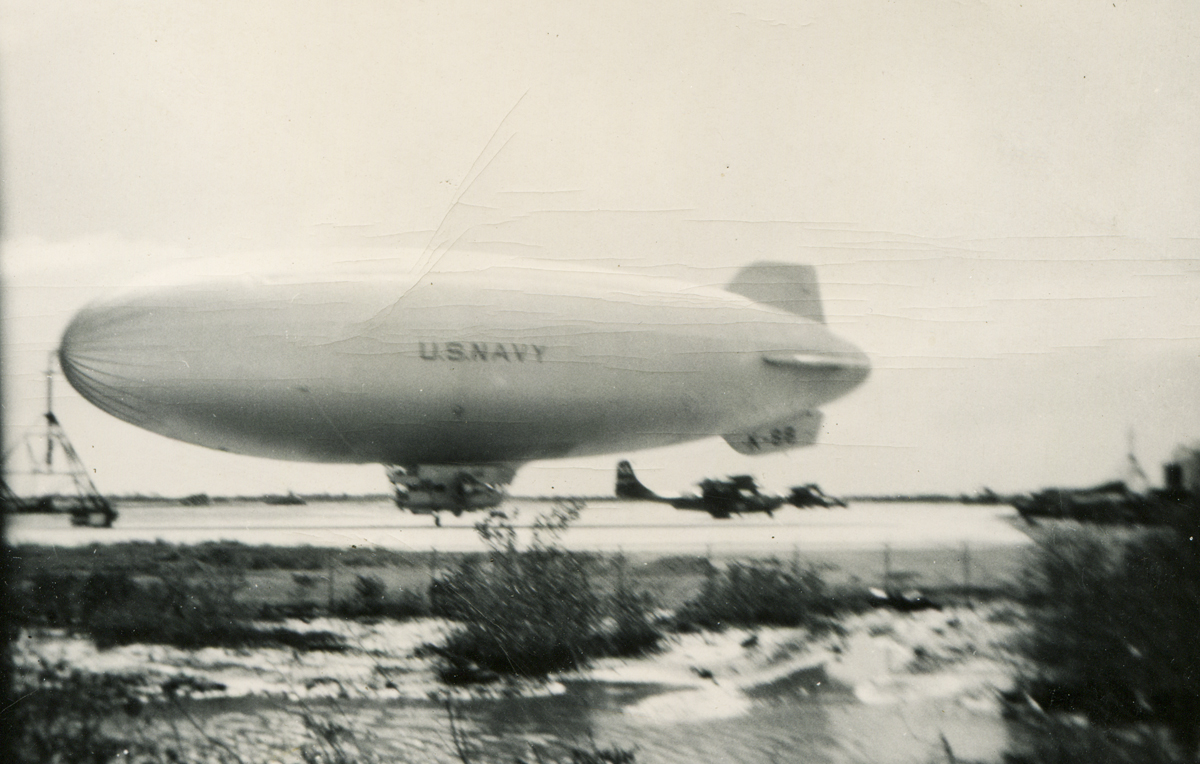
K-88 dwarfs several PBY Catalina flying boats on the ramp. 
The photo gives no indication of location, although Lakehurst
New Jersey is a strong possibility.
"Hey, it's the Goodyear Blimp!" is a common refrain as folks drive down the 405 in the LA area. Emphasis here on "the", as if a Goodyear blimp is a uniqueness. Once upon a time, it wasn't. In fact, during World War II, the Goodyear Aircraft Company built several hundred blimps for the Navy, which operated numerous squadrons of the non-rigid airships.

The blimps were built in several "classes", with the "K" class being the most numerous. The full Navy designation for these airships was "ZPK" (Z=lighter-than-air, P=patrol and K=class; followed by the individual ship's number). The K-class ships were based on Goodyear's L-class, which was their standard passenger and advertising model, and a total of 134 K-class blimps were built between 1938 and 1943.

The blimp shown in this week's featured photograph is K-88, which was part of the last batch of the class, ordered in mid-1943. Like its sisters, it was equipped for both day and night patrol flying, and had an ASG-type radar with a 90 nm range, as well as magnetic anomaly detection equipment. Their primary mission was anti-submarine warfare, a role in which the ship's 24-hour endurance helped greatly; the blimps were used in both the Pacific and the Atlantic, as well as the Mediterranean, for protection of shipping convoys against German U-boats. They were also often used in search-and-rescue missions, as well.

K-88 was assigned to Blimp Squadron ZP-41 in South America. Originally established as ZP-52 on June 15, 1943 at NAS Lakehurst, its designation was changed to ZP-41 a month later, and in September, its first airship, K-84, ferried to Fortaleza, Brazil, becoming the first non-rigid airship to cross the equator. In October, 1943, K-88 and K-90 both were sent to join ZP-41. In January 1944, ZP-41 moved its headquarters to San Luiz, Brazil, and that year, four more blimps joined the squadron.

After the war, plans were originally to transfer the airships to Brazilian ownership, but Brazil's cancellation of the LTA agreement precluded that. By November, 1945, the squadron had only one airship, K-52, so it is not clear when K-88 left. During the squadron's time in Brazil, they escorted a total of 5,608 ships, and did not have a single contact with an enemy submarine, and none of the ships escorted were attacked or sunk. The squadron was very active, however, in searches and rescues, both at sea and in the South American jungles.

K-88's gondola, upsided down and without most of its skin,
while stored outside of the RAF Millom Museum, awaiting
restoration. (Photo by Peter Clarke, used with his kind
permission.)
What happened to K-88 after it left Brazil is unclear at this point. Somehow, it ended up in the UK, either before or after its decommissioning from the Navy. The control car (aka gondola) as well as the engine pods have survived, loaned by the Navy to the Airship Heritage Trust and in turn on loan to the RAF Millom Aviation and Military Museum in Haverigg, UK (right; more photos of it are here, just scroll about 3/4 of the way down the page). Unfortunately, that museum closed in 2010 due to financial issues. Initially, K-88 was due to be sold at auction, but was withdrawn because of ownership issues, since the U.S. Navy typically asserts ownership forever; as of March 2011, K-88 was still at the Millom site. There is some talk that the gondola has or will be moved somewhere else in Europe for restoration and display, but further disposition of K-88 is unknown, and anyone with knowledge is invited to comment below.