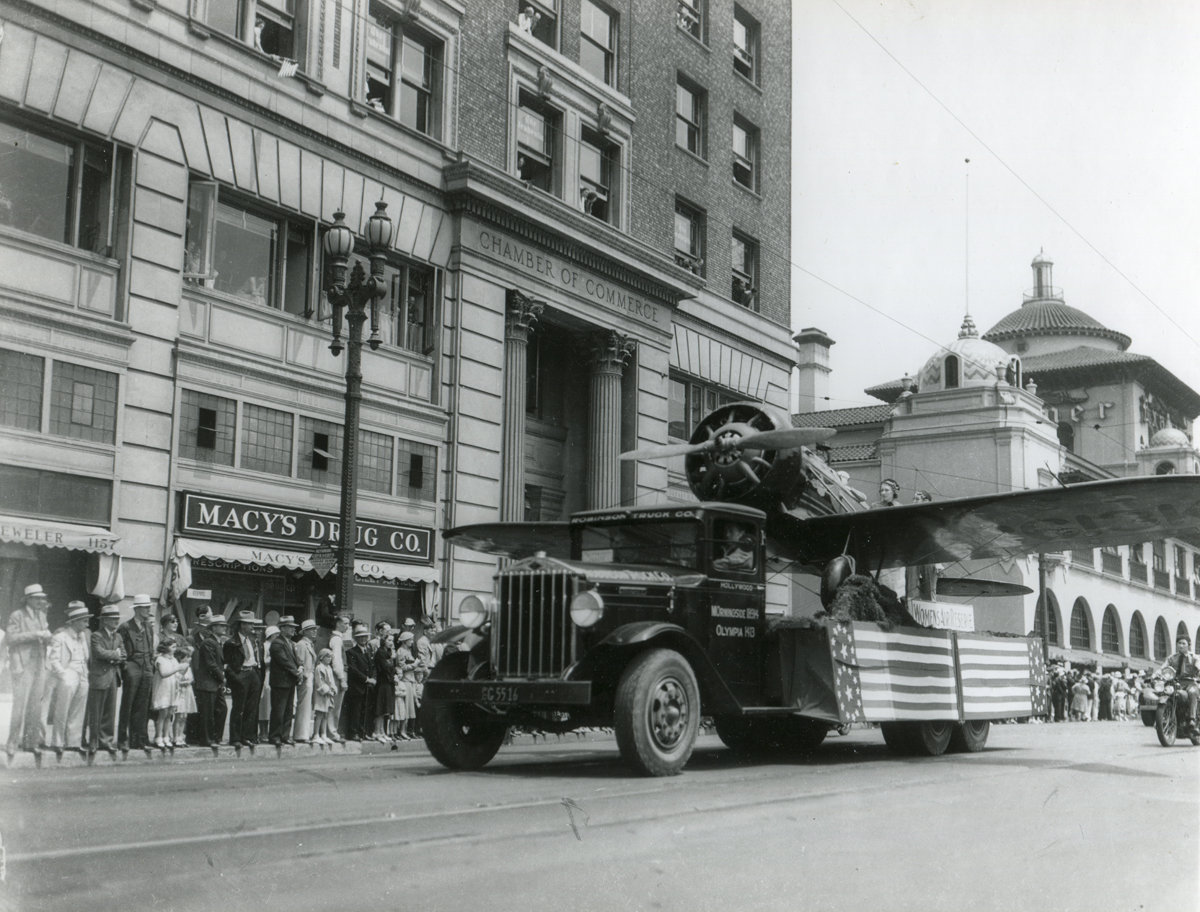
Last Friday, we posted the first photos from the recently-acquired William H. Alman collection. Today we continue drawing on this small-but-amazing set of previously unpublished images with today's first photo, which shows Pancho Barnes' Travel Air Model R, better known by its media-assigned name of "Mystery Ship", sitting on display next to Glendale's Grand Central Air Terminal.
The rest of the photos are original prints that come from the Mojave Transportation Museum collection.
 |
Pancho's Mystery Ship on parade promoting the Women's Air Reserve. If anyone
knows the date of this parade, please comment below! |
In the late 1920s, Walter Beech's Travel Air Co. of Wichita, Kansas was the world's largest aircraft manufacturer, and a powerhouse of aviation innovation, and produced a number of record-breaking and race-winning aircraft. In that era, records and trophies were one of the principal ways that aircraft companies promoted their products. On top of that, it was also an era when the US Army sent their best pilots to compete against civilians as contestants in various air races; typically, the Army would stay ahead of the civilians by using fighters with boosted engines, so they were typically the ones to beat.

Throughout the design and construction process, the Model R was a closely-guarded secret. First, Travel Air engineers Herb Rawdon (where the "R" in Model R came from) and Walter Burnham kept the project quiet from their boss until all the design details had been worked out, only ten weeks before the start of the 1929 National Air Races. Once Beech was briefed in, he enthusiastically endorsed the effort, as it showed potential for finally beating the Army at the Nationals.

Initially, Travel Air built two of the aircraft, one (Race 31, NR614K) powered by a 400 hp Wright J6-9 radial and the second (Race 32, NR613K) powered by an in-line 6-cylinder 165 hp Chevrolair D-6 engine (The Arthur Chevrolet Aviation Motors Corp was founded by Arthur, the brother of Louis Chevrolet, who stated the Chevrolet Motor Company, later part of GM). While these were under construction, a blanket of secrecy covered the factory, even to the extent that the building's windows were painted black. As a result, the very curious media (remember, air racing was a popular main-stream sport back then) dubbed the aircraft Travel Air's "Mystery Ships".

Once the aircaft were flown to Cleveland for the races, they were quickly tarped and reporters kept away. In the Thompson Trophy race, Doug Davis in #31 blew away the competition, the first time a civilian aircraft had won (mone on this in next week's post). Meanwhile Race #32 was also a winner at the 1929 Nationals, taking top place in the Experimental Class at 113.38 mph with Doug Davis again at the controls. After the races, the experimental Chevolair engine was removed and returned to the manufacturer, while the airframe was shipped back to Wichita, where it was modified to accommodate a Wright J6. It was then sold to Pancho Barnes.
Pancho used 613K to set a number of speed records, but the most famous of them was when she flew the aircraft over a closed-course at Van Nuys and shattered Women's speed record, previously held by Amelia Earhart, with a blazing 196.19 mph on August 5, 1930.
When her fortunes fell, Pancho sold 613K to Paul Mantz, who first used it in movie work, and then when it was no longer airworthy, displayed it at his Movieland of the Air museum. After Matnz' death, the plane was put up for auction, and when Pancho herself showed up to try to buy it back, she carried such respect from the aviation community that no one else was willing to bid against her. The Mystery Ship sat for years at Barnes Aviation's Lancaster CA hangar, slowly undergowing a restoration by Pancho's son Bill. When he was killed in a P-51 crash, the aircraft was again sold, this time to a collector in the UK, where for quite a while it once again became cloaked in secrecy while undergoing a pains-taking restoration, only recently reappearing, thanks to the efforts of Nick Spark, who produced the bio-pic
The Legend of Pancho Barnes and the Happy Bottom Riding Club. An article on how he found the plane, along with some recent photos of it,
can be found here.
A nice detailed history of the Mystery Ships
can be found here.