Showing posts with label Consolidated. Show all posts

Tuesday, December 13, 2011

The First Liberator

Today's photo starts a new series of press-release wirephotos which originally came from the St. Petersburg Times and which were recently acquired by MojaveWest. For those unfamiliar with wirephotos, they were essentially faxes, with the technology having been developed in the 1920s and 1930s (a fascinating article from Popular Science in 1935 about the technology can be found here). The amazing thing about wirephotos is that they were able to produce high-quality photo prints transmitted across old-fashioned telephone lines, decades before fax machines became popular - and the typical fax quality doesn't even come close to the image clarity that wirephotos have, as you can see here.

This is a tale about what happens when someone has a better idea than what was proposed, and doesn’t give up when that idea fails to meet expectations the first time around; it’s a story which demonstrates that a superior idea will win out in the end, and really can exceed the original expectations. It's also a demonstration that you can't always trust media releases to be accurate. But, since we're telling the stories behind the photos, let's at least look at the photo first:

The official caption accompanying this wonderful old image reads, "ARMY'S NEW SUPER BOMBER TESTED
SAN DIEGO, CAL. - The Army Air Corps' new bombardment plane, technically known as the XB-24, pictured after completing initial test flights at Lindbergh Field, San Diego. The four-motored plane, of all-metal construction, is capable of a speed of 300 miles an hour and a range of approximately 3,000 miles and a bomb carrying capacity of approximately 4 tons. It has high wings with a span of 110 feet. The motors are 18 cylinder, twin row radials, air-cooled. The propellers are three-bladed and 12 feet in diameter. A crew of six to nine men will fly the ship, which was built by the Consolidated Aircraft Corporation. Credit line (ACME) 2/12/40."

Dittoed caption pasted to the back
Not so fast! The numbers touted to the public weren't even close. That's where the "fails the first time" aspect of our moral comes in, and to understand that, we need to look at the "better idea" part. In 1938, the Army Air Corps needed more B-17 Flying Fortresses, and they needed them faster, so they approached company officials at Consolidated Aircraft in San Diego, to inquire about the ability of that company to crank out B-17s under license. But the Consolidated folks decided that they could do the Army one better, and offer a bigger, faster and longer reach bomber for the same effort - a belief which resulted in the Model 32, designed around twin bomb bays, each one having the capacity of a B-17. Intrigued, the Air Corps issued a set of specifications in January 1939, designed so that the Model 32 - redesignated the XB-24 - would be an automatic winner, and then invited Consolidated to submit a design. It was from this specification that the numbers in the press release text quoted above were derived.

After its first flight on December 29, 1939, it became apparent that the XB-24 fell quite short of the goals. Rather than the specified 311mph, the plane could, full bore, eek out a mere 273mph top speed. There were other issues, as well. The aircraft was redesigned with different engines and a slightly changed tail, and re-christened the XB-24B, with a bit more success. Even so, the top speed never met the specs...being listed for production aircraft at 290mph. Instead of a 3,000 mile range, it could only go 2,100 miles, and that only when empty. When loaded with the four tons of bombs that the press release touted, its range was a measly 400 miles!

Even so, it was considered one of the most successful aircraft designs of the war, and 18,482 aircraft were produced (compared to only 12,731 B-17s). At peak production, B-24s were pumped out at a rate of one aircraft per hour!

In 1944, the now-XB-24B was modified to be used by Consolidated as a VIP transport, an assignment which didn't last long. On June 20, 1946, this historic aircraft was unceremoniously scrapped at Brookley Field, in Mobile, Alabama.

Friday, September 30, 2011

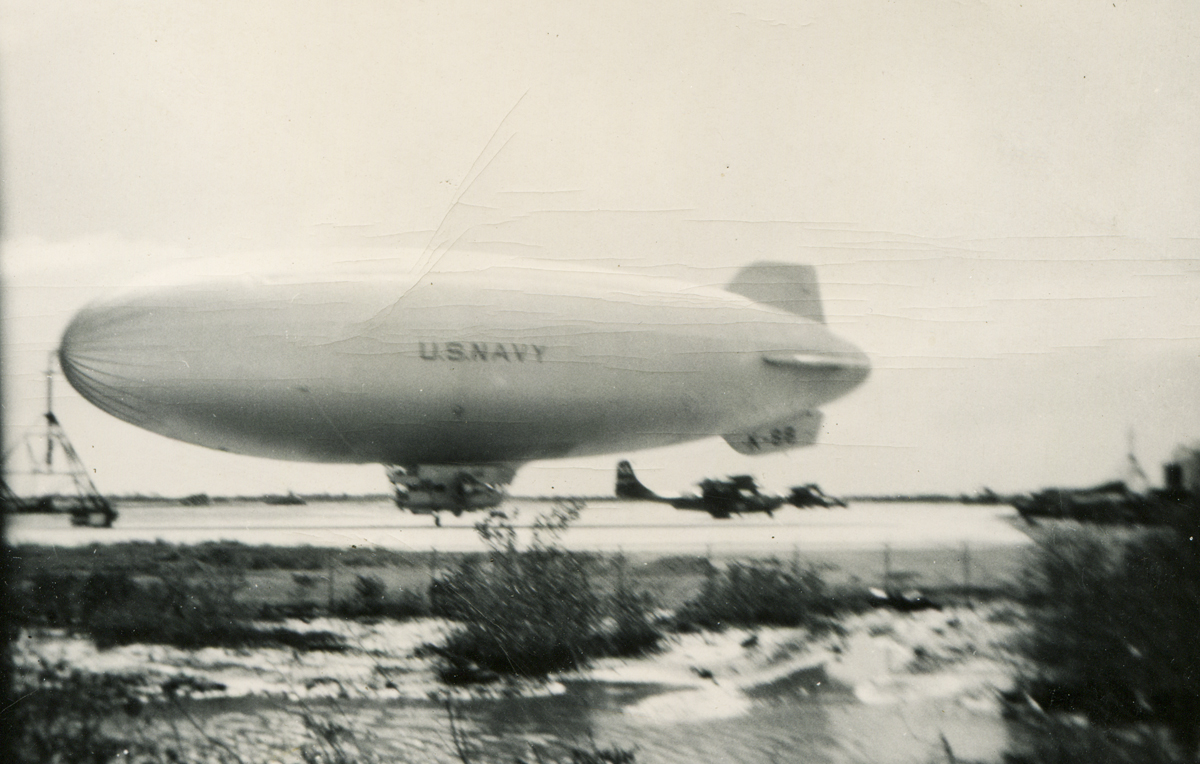
Just Another Goodyear Blimp

K-88 dwarfs several PBY Catalina flying boats on the ramp. 
The photo gives no indication of location, although Lakehurst
New Jersey is a strong possibility.
"Hey, it's the Goodyear Blimp!" is a common refrain as folks drive down the 405 in the LA area. Emphasis here on "the", as if a Goodyear blimp is a uniqueness. Once upon a time, it wasn't. In fact, during World War II, the Goodyear Aircraft Company built several hundred blimps for the Navy, which operated numerous squadrons of the non-rigid airships.

The blimps were built in several "classes", with the "K" class being the most numerous. The full Navy designation for these airships was "ZPK" (Z=lighter-than-air, P=patrol and K=class; followed by the individual ship's number). The K-class ships were based on Goodyear's L-class, which was their standard passenger and advertising model, and a total of 134 K-class blimps were built between 1938 and 1943.

The blimp shown in this week's featured photograph is K-88, which was part of the last batch of the class, ordered in mid-1943. Like its sisters, it was equipped for both day and night patrol flying, and had an ASG-type radar with a 90 nm range, as well as magnetic anomaly detection equipment. Their primary mission was anti-submarine warfare, a role in which the ship's 24-hour endurance helped greatly; the blimps were used in both the Pacific and the Atlantic, as well as the Mediterranean, for protection of shipping convoys against German U-boats. They were also often used in search-and-rescue missions, as well.

K-88 was assigned to Blimp Squadron ZP-41 in South America. Originally established as ZP-52 on June 15, 1943 at NAS Lakehurst, its designation was changed to ZP-41 a month later, and in September, its first airship, K-84, ferried to Fortaleza, Brazil, becoming the first non-rigid airship to cross the equator. In October, 1943, K-88 and K-90 both were sent to join ZP-41. In January 1944, ZP-41 moved its headquarters to San Luiz, Brazil, and that year, four more blimps joined the squadron.

After the war, plans were originally to transfer the airships to Brazilian ownership, but Brazil's cancellation of the LTA agreement precluded that. By November, 1945, the squadron had only one airship, K-52, so it is not clear when K-88 left. During the squadron's time in Brazil, they escorted a total of 5,608 ships, and did not have a single contact with an enemy submarine, and none of the ships escorted were attacked or sunk. The squadron was very active, however, in searches and rescues, both at sea and in the South American jungles.

K-88's gondola, upsided down and without most of its skin,
while stored outside of the RAF Millom Museum, awaiting
restoration. (Photo by Peter Clarke, used with his kind
permission.)
What happened to K-88 after it left Brazil is unclear at this point. Somehow, it ended up in the UK, either before or after its decommissioning from the Navy. The control car (aka gondola) as well as the engine pods have survived, loaned by the Navy to the Airship Heritage Trust and in turn on loan to the RAF Millom Aviation and Military Museum in Haverigg, UK (right; more photos of it are here, just scroll about 3/4 of the way down the page). Unfortunately, that museum closed in 2010 due to financial issues. Initially, K-88 was due to be sold at auction, but was withdrawn because of ownership issues, since the U.S. Navy typically asserts ownership forever; as of March 2011, K-88 was still at the Millom site. There is some talk that the gondola has or will be moved somewhere else in Europe for restoration and display, but further disposition of K-88 is unknown, and anyone with knowledge is invited to comment below.