Showing posts with label Mike Machat. Show all posts

Tuesday, January 29, 2013

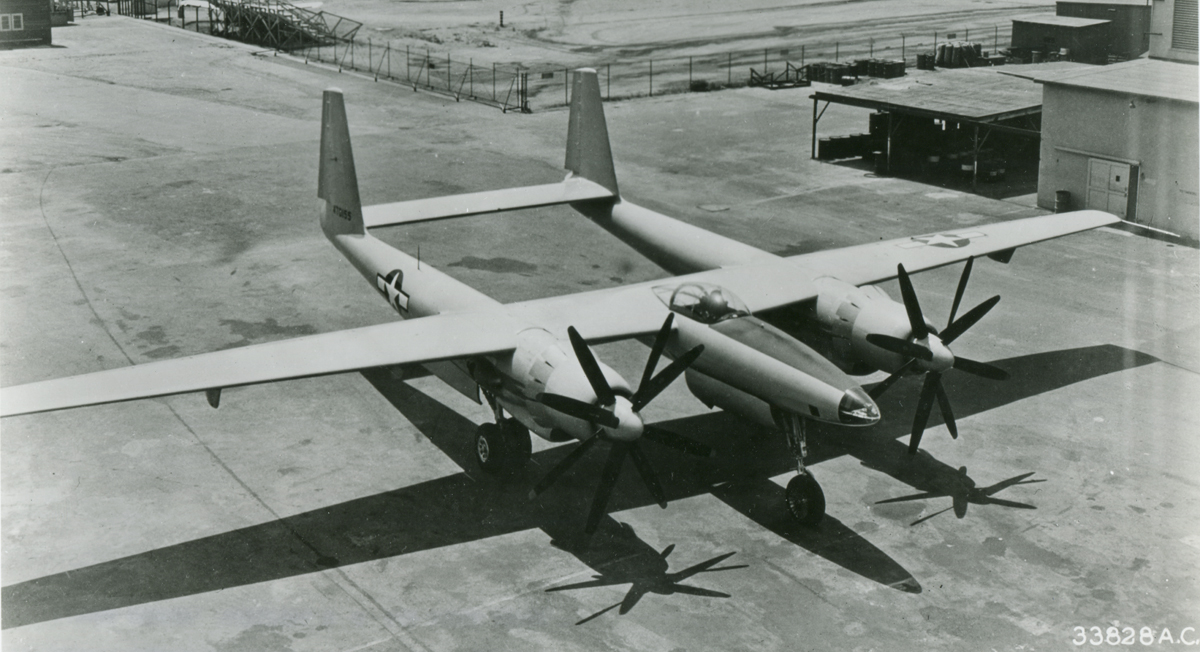
Portrait of the XF-11

Towards the end of WWII, the Army Air Forces decided that they needed a new high-speed, long-range photo reconnaissance aircraft, and so a competition ensued between Republic’s XF-12 Rainbow and the Hughes XF-11 (Hughes apparently didn’t give a name to his design). As I’ve mentioned before in the post (here) on the XR-12, the competition and the aircraft are covered in detail in Mike Machat’s book World's Fastest Four-Engine Piston-Powered Aircraft: Story of the Republic XR-12 Rainbow.

Because the first of the two XF-11 prototypes crashed – and almost killed Howard – during its maiden flight on July 7, 1946, Machat comments that “Any photograph of the first XF-11 should be considered rare.”
So I was delighted when the Archive had the opportunity to acquire an original Air Force print of the aircraft, taken during an official “portrait” session with the aircraft, when the plane was posed and shot from all angles on the ramp at Hughes Aircraft. The back of the 8x10 glossy is stamped, in blue ink, “Hughes XF-11 3/4 front view on ground. Please credit: Official U.S. Air Force Photo” (which indicates that the print was made after the USAF became a separate service in 1947. The print paper is 8x10, but the actual image is of the aspect ratio shown in the scan here).

The XF-11 was an extremely innovative design, and was one of the fastest aircraft of its day. With a pressurized cabin and a wingspan of over 100 feet, this high-altitude recon ship was equivalent in size and mission (if not range and endurance) to today’s Lockheed U-2 and Northrop Grumman Global Hawk. Unfortunately for Hughes, as good as the XF-11 was, the Republic offering was better (it had inflight access to the cameras, and even an on-board darkroom!), and the high-expense of both aircraft doomed them in a post-war era of shrinking budgets and impending jet age.

The crash of the first XF-11 was dramatized in the bio-pic The Aviator, and additional photos of the incident can be seen at this Check Six website. Wikimedia also has a copy of newsreel coverage of the crash. 

Friday, December 2, 2011

Vanishing Rainbow

For the September issue of AirshowStuff Magazine, I wrote a piece on Mike Machat's new book profiling the remarkable Republic XR-12 Rainbow (you can read it here, it's on page 14), an experimental reconnaissance aircraft from the mid-1940s, a design that was far ahead of its time; only two prototypes were built, and the program was cancelled before it could go into production. Mike, who is a well-known aviation painter, writer and speaker, was wonderfully generous with his time, allowing me a long and detailed interview over drinks and appetizers before he was to make a book-signing appearance. His passion for the history of both the Republic Aircraft Corp and the Rainbow is remarkable and very personal, as his uncle was one of the engineers that helped design the plane.

And then I went home and actually read the book he wrote (World's Fastest Four-Engine Piston-Powered Aircraft: Story of the Republic XR-12 Rainbow, available at a nice discount here), and fell in love with the plane myself. I was also intrigued to find out that the Rainbow actually made at least one airshow appearance, which made it an ideal subject to be featured both in my "Vintage Wings" column in the magazine (it just ran in the November/December issue, on page 6), as well as on this blog. Mike had just the photo, one that hadn't run in the book. The image was taken in October, 1948, at the open house at Wright Field, and shows the second of the two XR-12s that were built. While the first ship was essentially a handling qualities flight test vehicle, the second one had a full interior, including all the reconnaissance cameras and even a darkroom.

This photo, and one from a different angle that was used in the book, are unique. As Mike tells it, "It is very possibly one of the last photos ever taken of the airplane, because one week later it left for operational testing at Eglin AFB, FL, and crashed on only its second test flight there on November 7th." Of the seven-man crew,  only five survived the watery crash.

Mike Machat also generously provided this Republic family
portrait of the first XR-12, shortly after it's rollout together with
a P-47N Thunderbolt and an RC-1 Thunderbolt amphibian, the
forerunner of the RC-3 Seabee, a family-friendly amphibian that
Republic had pinned its hopes on to make big with an
anticipated post-war customer base of ex-military pilots. The
economics just didn't pan out, though.
The aircraft was faster than anything in its class, and Republic had dreams of a variant also being produced as a 40-passenger airliner, the RC-2 Rainbow. Both Pan Am and American Airlines had placed orders, as it was about 100 knots faster than its Boeing and Douglas competition. Unfortunately, it was an expensive project that came about at just the wrong time. With the end of WWII, its mission evaporated, and the Pentagon decided to pass. Without the military version to fund development of the civilian airliner, the price that the airlines would have to pay soared, and both carriers cancelled their orders. It was the end of the Rainbow, and there simply was no gold there.