Showing posts with label Stearman. Show all posts

Saturday, July 30, 2016

Stearman Star: Before She Was Famous

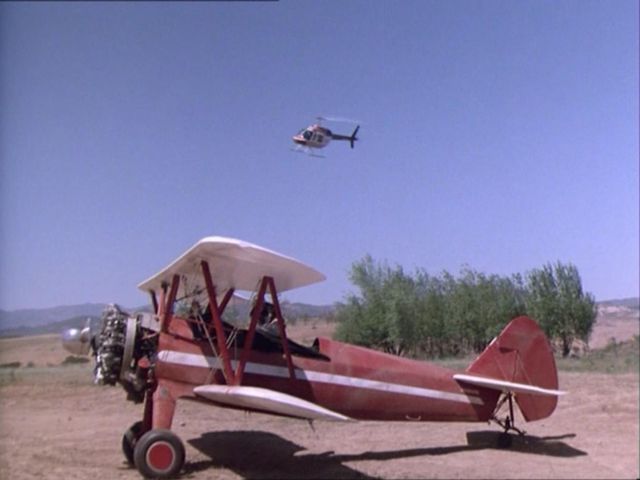
By and large, the planes featured in our vintage photos haven't survived into the 21st century. So when my brother, Eric Radecki of Vonrad Vintage in Fresno, discovered this old 8x10 glossy print and donated it to the archive, I made the assumption that the Stearman's hazardous line of work probably meant it hadn't survived, either. Was I wrong! Boeing Stearmans, to be sure, a durable and hardy lot, and N68405, built as a PT-17 in 1943 (c/n 75-7759), is one of those happy exceptions, and this is yet another example of a random, lost photo uncovering a fun story!


N68405 at Hawke Field, Merced CA on September 19, 1977.
Photo courtesy of Geoff Goodall, used with permission
The Steaman was a mere 20-something years young when an unknown photographer took this photo of the beginning of a crop dusting pass - under the wires! - in the mid-1960s. Today, N68405 is a movie and TV veteran owned and flown by Michael Samuel Mason, she graces the skies above Sequim, Washington (more about that in a minute!).

After serving (and surviving) as an Army Air Corps trainer in World War II, the Stearman was surplussed into the crop dusting world (an old duster I once knew told me "If you want to be a crop duster and live to 50, start at 49." I presume that goes for the planes, too!). In the above right photo by Geoff Goodall (from his website), our girl is seen still hard at work in September, 1977 at the Flying M Ranch's Hawke Field near Merced, California.

Production still from Airwolf as found on the "Wings-on-Film" Wikia
Like so many dreaming of stardom, the Stearman eventually left the farm and headed for Southern California and the world of movie and TV flying. When Airwolf debuted as a mid-season replacement show in the spring of 1984, N68405 made a guest appearance in the 11th episode, To Catch a Wolf (this same episode also features an appeance of the C-133s in the Mojave boneyard!). While owned by Mike Dewey, the Stearman was also flown in the Bruce Willis/James Garner comedy western Sunset. 

Before Mason bought it, the old gal was owned by Eric Newman and was used in Independence Day. The original ending envisioned for the movie included a suicide mission inwhich the Stearman (instead of the F/A-18 used) was flown up into the evil alien ship (you can see that version in this YouTube excerpt).

Our Stearman has also appeared in several music videos, including Aerosmith's "Amazing" (she shows up at 5:33 in this version on YouTube), and there's some gorgeous footage of the bright red Stearman doing aerobatics in the official music video for Mark Wills' "High, Low and In Between" (you can see it here on YouTube).

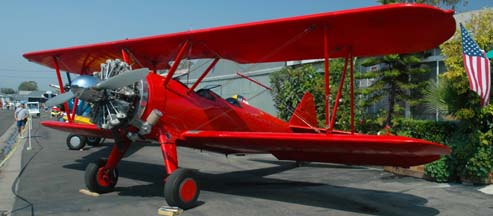
Photo by Brian Lockett, linked by permission
In August, 2005, aviation photographer Brian Lockett caught up with N68405 on display at the Santa Paula Airfair (right). Current owner Mike Mason grew up in Santa Paula, and his uncle still has two other Stearmans based there. Now in Sequim, Washington, Mike and and his wife Marilyn use the plane as a training platform in their unique Mason Wing Walking Academy, the only such school in the world! (They still do a bit of movie and TV work with it as well.)

Just as the name suggests, anyone with the $850 fee and an adventurous spirit can spend a day or two learning how to wing walk on top of this bright red Steaman. Mike does the flying, and Marilyn does the instructing. The world-wide population of wing-walkers is relatively small, as one might guess, and over 90% of them have been trained by Marilyn. One recent Academy student was Boston Marathon bombing survivor Megan Williams, and her experiences learning to wingwalk, profiled in an article in this great Sequim Gazette article, helped in her recovery journey.

It's wonderful to see this beauty still going strong a half-century after our feature photo was taken. One presumes that these days, Mason and crew keep a safer distance from power lines!

Courtesy of Mike Mason, Mason Wing Walking Academy
(Huge thanks to Eric for the print and Mike Mason for taking the time to share the past of his Stearman!)


Tuesday, October 1, 2013

Top 10 from the 2013 Flabob Flying Circus

I'm going to break with tradition this week, and instead of featuring vintage photos in this special mid-week post, I'm sharing some photos of vintage aircraft that appeared at this past weekend's Flabob Flying Circus in Riverside, California. For those not familiar with it, the annual event at Flabob Airport is a magnet for antique and classic airplanes, and the relaxed atmosphere there allows fly-in spectators to mingle with planes and pilots the way airshows used to be. If you're a fan of classic planes, make sure to add this to your calendar next year. Since there was no judging or prizes for the best aircraft on display, I thought I'd offer up the official Vintage Air top-ten list (meaning my personal faves!).
In first place was this knock-your-socks-off, absolutely gorgeous art-deco paint scheme on a beautifully restored Travel Air D-4D owned by Richard Zeiler. Named Sky Siren, the 1929 beauty was restored by AeroCraftsman and painted by Flabob fabric and paint guru Nando Mendoza.


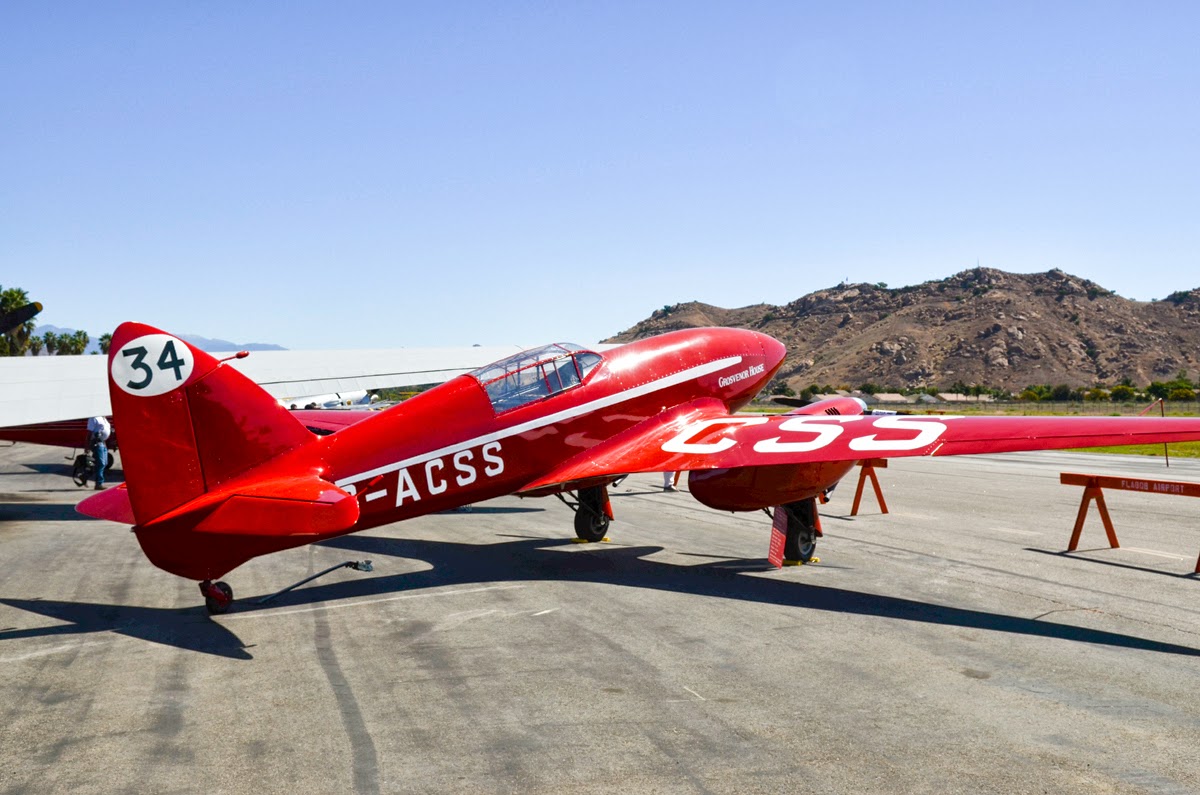
Second place goes to a plane that is well-known to Flabob visitors, the replica DeHavilland DH.88 Comet Grosvenor House. Built by the late Bill Turner for Tom Wathen (who owns several other Golden Age replicas, as well as the airport itself!). The original DH.88 was designed and built by DeHavilland specifically to be entered in the 11,000 mile UK-to-Australia MacRobertson Trophy race in 1934. Flying against a daunting field that included Douglas' new DC-2 and Boeing's 247.

When the race was over, the DH.88 had beaten its next closest rival, the KLM DC-2 by almost a full day, this despite having to finish the last legs with one engine throttled back due to oil pressure problems.


Third place goes to this highly modified Ryan owned by Gary Jackson. Originally an Army PT-22 (c/n 1391, AAF s/n 41-15361), it was modified by John Gokchoff's Component Air at Santa Paula with the installation of a Fairchild Ranger 6-410B engine which approximates the original Menasco engines used in the ST-A sport trainers that Ryan first built.


In fourth place is this super-clean 1930 model Travel Air 4000, owned by San Diego dentist Stuart "Cap'n Mac" MacPherson, who started his aviation career years ago flying in Richard Bach's Great American Flying Circus (hence N4321's current colors).


Fifth place (and a fair amount of curiosity) goes to this Curtiss "XF9-1" replica-of-sorts. Approximating the Curtiss XF9C/F9C Sparrowhawk, the detail that's gone into this beauty is astounding.

The aircraft's FAA registration records lists this as a John Pike-built Model 1929XF, with a year of manufacture of 2010.


In sixth place is this utterly gleaming 1946 Beech D18S, owned by Rick Loomis. As much as I'd love to own a Twin Beech, I'd hate to have to polish this one!


Seventh goes to this purple A75N1 Stearman (purple, unfortunately, doesn't "translate" well in digital photography) that flew down from Washington for the event.


In 8th place, with more gleaming aluminum is Lee Maxson's 1951 Cessna 195, which flew in from Chandler, AZ.


Ninth goes to the replica 1905 Wright Flyer which is still being built at Flabob, but which was far enough along to taxi down the crowd line. My neck hurts just thinking about trying to fly in that position.


And tenth, out of many, many more fabulous planes on the Flabob ramp, is this WACO UPF-7 from Gilbert, AZ.


Finally, we were saddened to see this beautiful 1937 Rose Parrakeet suffer a rather nasty groundloop on landing, but thankfully the pilot was able to walk away. It is seen here being righted, though one cringes at the thought of the stresses on that crankshaft! Hopefully, repairs will be forthcoming!


Tuesday, August 6, 2013

Legends: Grand Central and the First DC-3

Sometimes, even staged publicity photos capture really remarkable moments in time. Such is the case with today's photo, an 8x10 glossy press print officially issued by Americn Airlines in 1937. Shown is American Airlines' Flagship Texas, which many consider to be the very first Douglas DC-3. If this photo looks familiar to Glendale enthusiasts, it is because it is a very similar view to the photo used on the cover of John Underwood's seminal book Grand Central Air Terminal. However, a glance at the aircraft in the background shows that this was taken on a different day.

The caption accompanying this press photo reads, "With the crew in place, all that remains are the passengers, shown boarding the Flagship for an overnight flight to New York. The plane is ready for the take-off from Grand Central Air Terminal Glendale, Los Angeles terminal for American Airlines, Inc." The photo is stamped "American Airlines" and was received and filed in the reference department of the National Editorial Association on November 3, 1937. A close look shows the nose number to be A-115, the Flagship Texas.

Only, this wasn't exactly a DC-3. The visual give-away are the small slit-like windows above the normal passenger windows, and the note in the caption about this being an overnight flight to New York: this is the first Douglas DST-144, the Douglas Sleeper Transport. A couple of years ago, posts here recounted how the DC-1 and DC-2 came into being at the behest of TWA's Jack Frye, and so it's fitting that we follow with the similar story of how the DC-3 was born.

American Airlines was enjoying moderate success with the idea of adapting Pullman railroad-style sleeping berths to air transportation with their Curtiss T-32 Condor, but those aircraft became instantly obsolete when the DC-2 took to the air. With Boeing selling the 247 exclusively to their sister company, United Airlines, American's C.R. Smith and his engineers took a look at the DC-2, but it didn't have as much power as they would have wanted, and more importantly, the fuselage was too narrow for the sleeper berths. So American's chief engineer, William Littlewood, sat down with his engineering staff to see if they could come up with a redesign of the DC-2 that would meet their needs. With notional sketches in place, Littlewood then approached Douglas' chief engineer, Arthur Raymond with the concept, and Raymond refined the drawings and authored an internal report the outlined the logical follow-on to the DC-2 design.

Then it was up to Smith to pitch the idea to Donald Douglas himself. Douglas initially said no. Now, TWA had started the DC-2 production with an unheard-of order of 25 aircraft, and the Douglas plant was in full swing cranking these out, as well as DC-2s for other customers. It was clearly a successful design - even though it didn't meet Smith's requirements - and in those times (remember, this is only five years or so after the start of the Great Depression, a time when capital investment by corporations was severely limited), Donald Douglas was understandably reluctant to divert resources from such a successful program and invest in something new and speculative. It was not until Smith upped the ante with an offer to order at first 10, and then 20 of the new, bigger aircraft that Douglas saw the financial benefit of pursuing the design. Smith financed the development of the design with a loan from the Reconstruction Finance Corp., a government entity set up to jumpstart the nations economy.

American and Douglas engineers worked together as one team to come up with the detailed design for the DST. American loaned Douglas a Condor so that the berth design could be improved on...and one detail that the engineers noticed during the time they spent in the upper berth of their mockups was that it was easy to feel claustrophobic there, so they added the small slit windows (a photo of the berth configuration can be seen here). Since the standard-seat DC-3s don't have these berths, they understandably don't have the slit windows.

What resulted was essentally a larger, wide-body version of the DC-2, and ultimately used very few parts in common with the -2. But once Donald Douglas embraced the design, he didn't just stop at the sleeper version, but saw that there would be a ready market for a version that had only traditional seating, a version he designated as the DC-3. Eventually, Smith modified the order so that it consisted of eight DSTs and twelve DC-3s A total of 40 DST and DST-As were produced, but over 10,000 DC-3s and related civilian and military variants were built in the US, and another 5,000 were license built in Russia. (A much more detailed history of the development of the DST can be found here.)

The first DST, NX14988 (Douglas c/n 1494), took to the air on her maiden flight on December 17, 1935, a mere 32 years to the day after the Wright Brothers' first flight, and only seven months after Raymond's original report had been written! The crew consisted of Carl Cover, Fred Collbohm and Ed Stinemann. After initially serving as a flight test aircraft, the plane was finally delivered to America with an NC registration and became their nose number A-115 and was named Flagship Texas. The Texas was formally accepted by American on April 29, 1936 and "Flagship Service" with the new planes was kicked off on June 26, 1936, with inaugurations featuring the Flagship New York at Newark NJ and Flagship Illinois at Chicago. By the end of 1936, Donald Douglas' gamble had paid off, and American had possession of their twenty aircraft, and ten more had been delivered to other carriers.

As for our plane, the Texas, in 1940 it was converted to standard 32-passenger DC-3 configuration. It was later sold to TWA to be used in flying Army cargo contracts, and then later sold to the War Department and the Army Air Corps (as serial 42-43619) and assigned to the 24th Troop Carrier Squadron. Unfortunately, it it crashed and was destroyed on 15 October 1942 during bad weather near Knob Noster, MO.

This photo is incredibly clear, and so in a high-resolution scan, the planes in the background can be clearly identified. It is thus fitting that one of them, the fartherst away from the camera, is the DST's predecessor, the DC-2, here in TWA colors.

In the foreground is another American Airlines aircraft, though one seemingly from a different era, NC482W, a Stearman 4-CM-1 Senior Speedmail. American had purchased a dozen of these sturdy biplanes from Stearman in 1930 to serve on airmail routes in the midwest. To see one at this late date on the west coast, and still in American colors, is a bit intriguing. In the middle is a Lockheed 10C Electra with Mexican registration. From the photo, though, it is difficult to distinguish whether this is XA-BEO or XA-BEQ...what I think may be the tail of a "Q" could merely be a shadow. BEO (which was originally NC14260) crashed on November 1, 1937 at Playa Vicente, and BEQ crashed at Tuxlax Volcano a year later on November 7, 1938.

On the left side of the background is a parked WACO cabin-class biplane. Because WACO offered so many models and variations in their cabin class line, it's tough from this photo for me to determine exactly what type is shown here.

Tuesday, August 28, 2012

Stearman's Odd-Man Out

In the late 1930s, the Army Air Corps solicited designs (to be built at the manufacturer's own expense) for a new light attack aircraft from five manufacturers. Stearman, which was a subsidiary of Boeing but operated independently, proposed a design which they called the X-100. The Army bought the prototype for testing, re-designating it the XA-21.

In its original form, as seen on the right, the pilot sat behind and above the bombardier under a common green-house style canopy. First flight took place in 1938, but initial testing showed that the pilot's forward visibility was less than ideal, and so the aircraft was returned to Boeing (who by then had re-absorbed Stearman) where it was modified with a more traditional nose, giving the pilot a regular windshield (you can see the difference in this photo from the Museum of the US Air Force). While the pilot gained better vision, the aircraft suffered a slight loss in airspeed from the added drag.

The Army still didn't bite, and only this one aircraft was built. The NA and the Douglas prototypes both crashed during testing, and Bell's proposal was withdrawn early on, before any hardware was built. Eventually, the Army cancelled the competition, but then revived it again, and all the originally competing designs were resubmitted, without hardware being required to be built. The winner of this paper competition was Douglas' Model 7B, which became the A-20 Havoc. The North American NA-20 design eventually was upgraded and entered into a medium bomber competition, to became the B-25 Mitchell. Martin went on to sell their Model 167F to the British to become their Maryland. Boeing chose, instead, to focus on the really big bombers.

Our image, an 8x10 glossy, apparently was a press publicity photo, and it ran in the June 1939 edition of Popular Mechanics Magazine (scroll down to pg 827).

A much more detailed history of the XA-21 can be found here.