Showing posts with label Travel Air. Show all posts

Sunday, August 16, 2015

The Tragedy and Triumph of the Dole

Eighty-eight years ago today, on August 16th 1927, one of the most tragic events of the Golden Age of Aviation began, an air race from California to Hawaii which, in the weeks before and after, dominated the American press.

8x10 press photo of the start of the Dole Air Race in Oakland, California on August 16, 1927. Caption pasted on the back reads, "General view of flying field where four planes took off for Honolulu in the Dole $35,000 prize air derby. The Oklahoma is seen on the starting line, with other planes in rear awaiting their turn. Underwood photo."


With the Atlantic Ocean conquered by Charles Lindbergh only three month earlier, the next biggest prize was the next biggest ocean, the Pacific. James D. Dole, the American entrepreneur who, with his Hawaiian Pineapple Company, had taken a South American fruit and turned it into a major plantation crop on the Hawaiian Islands. Dole was, however, at the mercy of the shipping lines, especially Matson, to get his crop to the mainland, and when Lindbergh won the Orteig Prize by demonstrating that aviation could conquer oceans, Dole realized that aviation could also, one day, delivery pineapples, and so should be encouraged. Thus, he posted a purse of $35,000 ($25,000 for first place, $10,000 for second place) for the first two planes which successfully flew from Oakland to Honolulu, a distance of about 2,400 miles, and which met a number of very specific criteria.

The irony is that the Army had already been planning such a flight, and utilized a large Fokker C-2 Trimotor known as the Bird of Paradise, flown by Lt. Albert F. Hegenberger and Lt. Lester J. Maitland. The pair successfully completed the flight in a time of 25 hours, 50 minutes, flying from Oakland to Wheeler Army Air Field. Because they didn’t land at Honolulu, they were disqualified from winning the Dole prize, but did secure the 1927 Macay Trophy, an annual award presented by the Air Corps (now Air Force) for the most meritorious flight of the year, as well as each receiving the Distinguished Flying Cross (Hegenberger would also go on to win the Collier Trophy for his work in developing blind flying techniques).

The first civilian flight to make it to the Islands also failed to secure one of the Dole prizes. Ernie Smith and Emory Bronte flew a Travel Air 5000 named The City of Oakland, departing on July 14, 1927. After a flight of 25 hours, 36 minutes they found themselves over the island of Molokai and out of gas, and with no airfields to land at, they had to settle for putting the plane down in some trees. And, of course, since they didn’t land at Honolulu, they, too, were disqualified from the Dole prize.

The City of Oakland departs its namesake in a bid to become the first civilian aircraft to fly across the Pacific to Hawaii. The goal was Honolulu, and they almost made it (see below).

"July 23 - Resting place of Smith's plane, City of Oakland, in a tree on the island of Molokai". Photo also includes an editorial note: "These four pictures [the archive only has one] of the Smith flight to the Hawaiian Islands were rushed by steamer back to the mainland, and thence by fast mail to all points."


For the rest of the teams planning on competing for the prize, a derby-style takeoff was planned for August 16th. In an expression of city pride, Oakland built a 7,020 foot runway, the longest in the world at the time, just for the event. To determine the order of departure, a drawing was held by the NAA at the Matson Building in San Francisco, an odd twist given Dole’s motivation for offering the prize.


Before the race even started, three planes, The Spirit of John Rogers, The Angel of Los Angeles and The Pride of Los Angeles (a unique twin-engined 22-passenger CF-10 triplane) crashed, resulting in three deaths and two injuries. Another, The Air King (City of Peoria) was disqualified by the race committee because they believed it couldn’t carry enough fuel for the trip. At least one other crewman was disqualified for not meeting skills requirements.

"Aug 11 - Disaster overtakes the 'Hoot' Gibson Triplane, Pride of Los Angeles as it attempts a landing at Oakland Airport after flying north from Los Angeles to enter the Dole fllight to Honolulu. Pilot James L. Giffin and companions prepare to abandon ship after crashing in the water a few yards from Oakland airport. Picture shows flyers, plane, shore, and runway of field in background, with swimer from shore bringing line to flyers. (Acme)"


On August 16th, a huge crowd - a large as 100,000 by some press reports - had gathered at the Oakland airport to see the racers take off. Oklahoma, one of two Travel Air 5000s competing, was flown by Bennett Griffin and navigated by Al Henley, was first, taking off just after 11am. They didn’t get far, though: the engine started overheating over San Francisco, and Griffin turned back.

The Travel Air 5000 Oklahoma waiting on the starting line. One of two Travel Airs sponsored by the Phillips Oil Company, Oklahoma turned back with a misbehaving engine.


Second in the lineup was El Encanto, a custom-built Goddard Special flown by Norman Goddard and navigated by Kenneth Hawkins. The odds-makers, before the race, had heavily favored this unique monoplane, but it didn’t even get off the ground, swerving and crashing on its takeoff roll.

Virtually the same thing happened to the Pabco Pacific Flyer, one of a pair of Breese-Wilde Model 5s entered. The plane was being flown solo by Livingston G. Irving, son of the mayor of Berkeley. Since Livingston was a decorated WWI pilot, he was able to qualify to fill both the pilot and navigator positions, so flew solo in order to be able to carry more fuel. But, fuel was his undoing. The plane was very heavily loaded, and on its first attempt he was not able to lift off, instead running off the end of the runway.

Fourth was the Hearst Papers’ Golden Eagle, the prototype Lockheed Vega, with Jack Frost and Gordon Scott. Unique and far advanced in both design and construction, Golden Eagle was filled with safety features and was another favorite to win, since it was clearly the fastest plane in the field of competitors.

The prototype Lockheed Vega, Golden Eagle, is delivered factory-new to the Oakland airfield, still wearing its original X-2788 registration. From left to right are race pilot Jack Frost, Lockheed test pilot Eddie Bellande, principal designer Jack Northrop, Allan Loughead (aka Lockheed) and Ken Jay.


Miss Doran, a Buhl, was fifth, and it too experienced engine problems right after takeoff. Flown by Auggy Pedlar with Vilas R. Knope as navigator, the plane was named for Mildred Doran, a Michigan schoolteacher who was to be the only woman, and the only passenger in the race.

Next was Dallas Spirit, a monoplane custom-built by the Swallow Airplane Company to fly in two prize flights: the Dole, and a $25,000 offering by William Easterwood for the first plane to fly from Dallas to Hong Kong. Flown by William P. Erwin and navigated by Alvin Eichwaldt, the Dallas Spirit fell victim to a mis-installed panel on the fuselage, which led to a large portion of the skin fabric ripping off shortly after takeoff. They were able to return to Oakland safely, but repairs would then take too long.

The Aloha takes off from Oakland.


Aloha, the second Breese-Wilde Model 5 then took off with Martin Jensen and Paul Schluter. Schluter wasn’t an aviator, but rather was a marine navigator who had seen an advertisement in the newspaper placed by Jensen. They were followed by the other Travel Air 5000, the Woolaroc, named after the Oklahoma ranch of sponsor and oilman Frank Phillips, and crewed by Arthur C. Goebel and William V. Davis, Jr. Phillips, of Phillips Petroleum, had sponsored both Wollaroc and Oklahoma as way of promoting the company’s Nu-Aviation brand of gasoline.

This Acme press photo is dated August 9, 1927, but doesn't give an location of where it was shot.


Miss Doran, her engine now fixed and running smoothly, departed a second time, followed by the Pabco Pacific Flyer. Since the plane wasn’t damaged when it ran off the end of the runway earlier, it was towed back to the starting line for another try. This time, Irving tried to lift off without sufficient airspeed, immediately stalled and landed hard, collapsing the gear.

So after all the hoopla, drama and carnage at Oakland, four planes were in the air and heading west, Golden Eagle, Aloha, Woolaroc and Miss Doran.

In Honolulu, there was great expectation the next day, and scores of people went to the field to await the arrival of the four contestants. Only two showed up. The first was Woolaroc, which had flown a great circle route in 26 hours, 17 minutes. Almost exactly two hours later, Aloha also arrived, having flown a more “direct” route (Schluter should have know better, and as a result, out of the $10,000 second place prize, Jensen only paid his navigator the advertised fee of $25!).

The Aloha arrives in Honolulu.


Photo donated by Vonrad Trading Post
To the distress of everyone, both the Golden Eagle and Miss Doran were no-shows, and officially listed as missing. Another $50,000 in reward money was posted by various parties to help spur the search for the missing planes and fliers. In Michigan, the loss of school teacher Mildred Doran was taken hard, an eerie foreshadowing of the reaction decades later at the loss of Christa McAuliffe in the Challenger accident. The Navy Secretary E. W. Everle authorized the largest ever search effort, and tasked three submarines, and several destroyers already on patrol in the Pacific with searching. All 28 patrol planes from the carrier USS Langley were launched, but despite all the effort, no sign was found.

The repairs to the Dallas Spirit took two days, and even though the prize money was all claimed, Erwin and Eichwaldt decided to make the flight anyways, and on the way try and search for the missing planes. After Hawaii, they planned to press on to their other goal of Hong Kong. Livingston Irving donated the short-wave radio from the Pabco Pacific Flyer, so that they could make calls in case they found signs of the lost planes. When they were about 650 miles west of Oakland, Eichwaldt sent out a call that the plane had gone into a spin, but that Erwin had managed to recover. This was followed shortly afterwards by another call, that they were in a spin once more. This message was interrupted midway through, presumably because the plane either broke apart or crashed into the water. No sign of wreckage was ever found. In the aftermath, the Dallas Spirit had been built by Swallow on the condition that the company receive some of the prize money from both the Dole and the Hong Kong flights. The loss of the plane - and thus the promised cash - was enough that Swallow had to declare bankruptcy.

No sign of Miss Doran was ever found, either. However, there is an enduring mystery surrounding the Golden Eagle. There were some indications that Frost had actually reached Hawaii...the big island, that is, and had crashed on the side of the Mauna Loa volcano. In the days after the race, reports started filtering in that people had heard an airplane engine over the island, that there had been sightings, one of which even said that the tail number, NX-913, had been seen (this was dismissed, because the number was so similar to the Aloha’s, NX-914). However, at least seventeen different witnesses, at different locations around the Big Island, reported seeing Very flares (named for Edward Very, the US Navy officer who had invented the flare gun) on the night of August 18th, and again on the night of the 21st.

Army Captain E. R. Block, who was stationed on the island, saw the flares, and was convinced that a plane was down, and he and a sergeant started out on foot up the mountain. Their mission, however, was interrupted when the sergeant suffered an appendicitis and they had to return to post. Relatives of the crew, and even Martin Jensen himself, became more and more convinced that the Golden Eagle had indeed gone down on Mauna Loa. Unfortunately, the 13,680 volcano was active at that time, and besides the steam and lava coming from its crater, the flanks were typically shrouded in fog, making an air search impossible during the rest of August. Careful interviews of the witnesses, which included testing their recognition of lights and flares fired in test from the mountain, all pointed to actual flares having been fired in a fairly defined area at the 8,000 foot level, in an area that was still a very hot lava flow.

No physical evidence of the Golden Eagle was ever found, but then again, a wooden airplane landing in that volcanic hell would have likely been quickly obliterated. Two years later, search efforts were still being undertaken, the final one including a large flight of Army mapping planes which photographed a 10-square mile area of the mountain with large-format cameras. Detailed scrutiny of the photos failed to provide even a single clue.

The Aloha was subsequently converted to a passenger plane and was used by the Hawaiian Air Tours company, before being returned to the US, where it served as an aerial photography platform for the New York Daily News. It was destroyed in a hangar fire in 1933.

Woolaroc is the only surviving plane of the race, and is on display at the Woolaroc Ranch Museum in Bartlesville, Oklahoma.


Saturday, January 3, 2015

Flight School Travel Air?

This old snapshot print is tiny...measuring only 2 1/4 inch wide, and came with no information about the subject. To me, it looks like a Hisso or OX-5 powered Travel Air 4000. Nice crowd of people around it suggests it's presence is an event. I'd be interested to hear from anyone with thoughts about where this was located (note the building sign that reads "Aviation Service and Transport - School of Aviation").

Tuesday, October 1, 2013

Top 10 from the 2013 Flabob Flying Circus

I'm going to break with tradition this week, and instead of featuring vintage photos in this special mid-week post, I'm sharing some photos of vintage aircraft that appeared at this past weekend's Flabob Flying Circus in Riverside, California. For those not familiar with it, the annual event at Flabob Airport is a magnet for antique and classic airplanes, and the relaxed atmosphere there allows fly-in spectators to mingle with planes and pilots the way airshows used to be. If you're a fan of classic planes, make sure to add this to your calendar next year. Since there was no judging or prizes for the best aircraft on display, I thought I'd offer up the official Vintage Air top-ten list (meaning my personal faves!).
In first place was this knock-your-socks-off, absolutely gorgeous art-deco paint scheme on a beautifully restored Travel Air D-4D owned by Richard Zeiler. Named Sky Siren, the 1929 beauty was restored by AeroCraftsman and painted by Flabob fabric and paint guru Nando Mendoza.


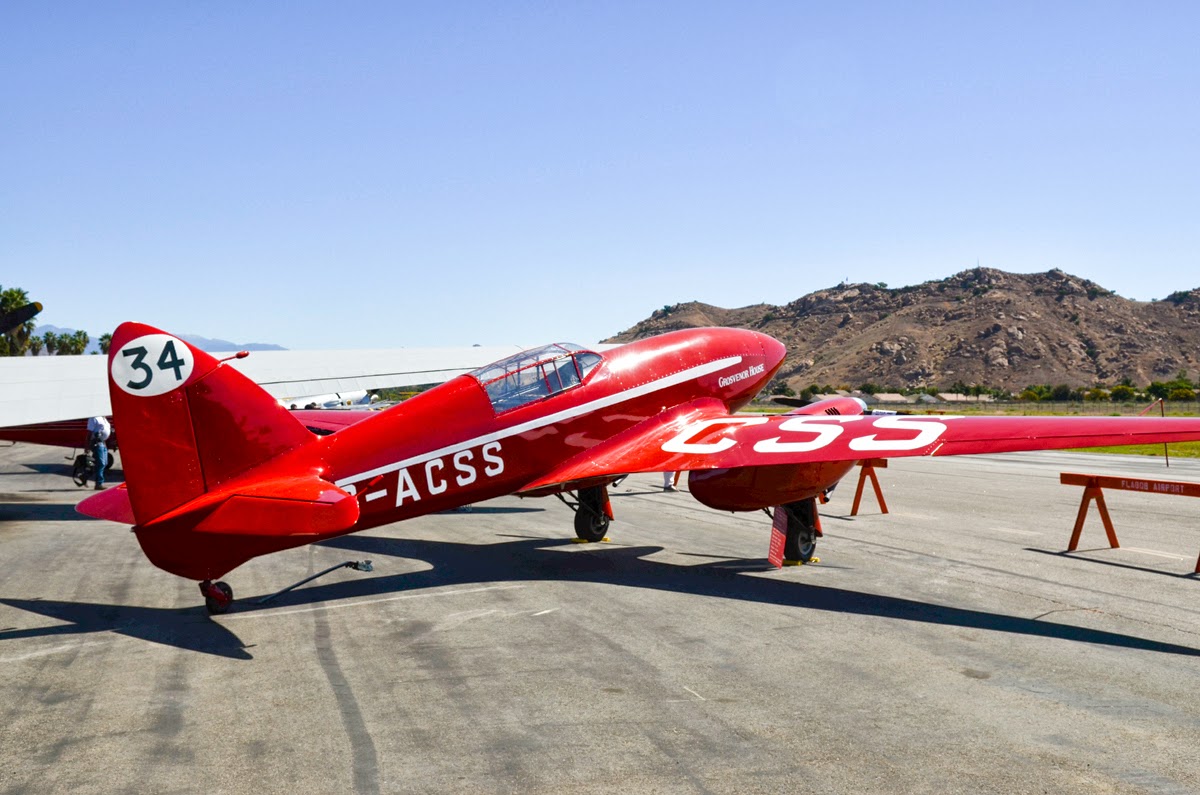
Second place goes to a plane that is well-known to Flabob visitors, the replica DeHavilland DH.88 Comet Grosvenor House. Built by the late Bill Turner for Tom Wathen (who owns several other Golden Age replicas, as well as the airport itself!). The original DH.88 was designed and built by DeHavilland specifically to be entered in the 11,000 mile UK-to-Australia MacRobertson Trophy race in 1934. Flying against a daunting field that included Douglas' new DC-2 and Boeing's 247.

When the race was over, the DH.88 had beaten its next closest rival, the KLM DC-2 by almost a full day, this despite having to finish the last legs with one engine throttled back due to oil pressure problems.


Third place goes to this highly modified Ryan owned by Gary Jackson. Originally an Army PT-22 (c/n 1391, AAF s/n 41-15361), it was modified by John Gokchoff's Component Air at Santa Paula with the installation of a Fairchild Ranger 6-410B engine which approximates the original Menasco engines used in the ST-A sport trainers that Ryan first built.


In fourth place is this super-clean 1930 model Travel Air 4000, owned by San Diego dentist Stuart "Cap'n Mac" MacPherson, who started his aviation career years ago flying in Richard Bach's Great American Flying Circus (hence N4321's current colors).


Fifth place (and a fair amount of curiosity) goes to this Curtiss "XF9-1" replica-of-sorts. Approximating the Curtiss XF9C/F9C Sparrowhawk, the detail that's gone into this beauty is astounding.

The aircraft's FAA registration records lists this as a John Pike-built Model 1929XF, with a year of manufacture of 2010.


In sixth place is this utterly gleaming 1946 Beech D18S, owned by Rick Loomis. As much as I'd love to own a Twin Beech, I'd hate to have to polish this one!


Seventh goes to this purple A75N1 Stearman (purple, unfortunately, doesn't "translate" well in digital photography) that flew down from Washington for the event.


In 8th place, with more gleaming aluminum is Lee Maxson's 1951 Cessna 195, which flew in from Chandler, AZ.


Ninth goes to the replica 1905 Wright Flyer which is still being built at Flabob, but which was far enough along to taxi down the crowd line. My neck hurts just thinking about trying to fly in that position.


And tenth, out of many, many more fabulous planes on the Flabob ramp, is this WACO UPF-7 from Gilbert, AZ.


Finally, we were saddened to see this beautiful 1937 Rose Parrakeet suffer a rather nasty groundloop on landing, but thankfully the pilot was able to walk away. It is seen here being righted, though one cringes at the thought of the stresses on that crankshaft! Hopefully, repairs will be forthcoming!


Friday, July 12, 2013

The First Mystery

R614K posing outside Travel Air's Wichita Hangar when she was fairly new.
Last week we took a look at our newly acquired photo of Pancho Barne's Travel Air Mystery Ship, this week we display the Archive's two prints of the first Travel Air Model R, NR614K, Race #31.

Built to beat the Army's fighters that were perennially winning the National Air Races, #31 stunned even its designers on its first flight with an airspeed that was 15% greater than what they'd predicted from their calculations.

During the 1929 Thompson Trophy race, pilot Doug Davis and the Mystery Ship were in the lead when he accidently cut a pylon, so he had to circle back and re-fly that particular turn. Back on course, Davis found himself at the back of the pack, but the little Model R was so fast that he caught up and passed all the other contestants. His average speed was an unheard-of 194.90 mph. The Army's entry, a Curtiss P3A, was a distant second with an average speed of 186.84 over the fifty mile course. Roscoe Turner in a Lockheed Vega was third, and a Navy Curtiss F6C-6 was fourth.

R614K still in her 1929 colors, but showing some wear (note the paint knocked
off around the tire pressure valve access hole in the wheel pant). An unident-
ified pilot is in the cockpit and the engine is running fast enough that the prop
is completely blurred in this exposure. 
The plane missed the 1930 races, but returned to Cleveland for the 1931 event. During a test flight before the Thompson Trophy race, 614K caught fire and pilot Walter Hunter bailed out. The plane was completely destroyed in the crash. The Type R came with two sets of wings, a short set designed for pylon racing, and a longer set used for cross-country flying. The long set from 614K has survived and are currently displayed at the Staggerwing Museum.

While Travel Air only built five of the Model Rs, a sixth one was built by Jim Youngkin (some sources say that it was built in 1979, the FAA registration lists the manufacture date as 1971, and the registration certificate issued 3/10/1976; a photo and writeup can be seen here). While termed a re-creation or replica, it was built meticulously from the original plans, and carries the registration number N614K. It is currently owned by the Staggerwing Museum Foundation, and appeared in the movie The Rocketeer.


Friday, July 5, 2013

Pancho's Mystery

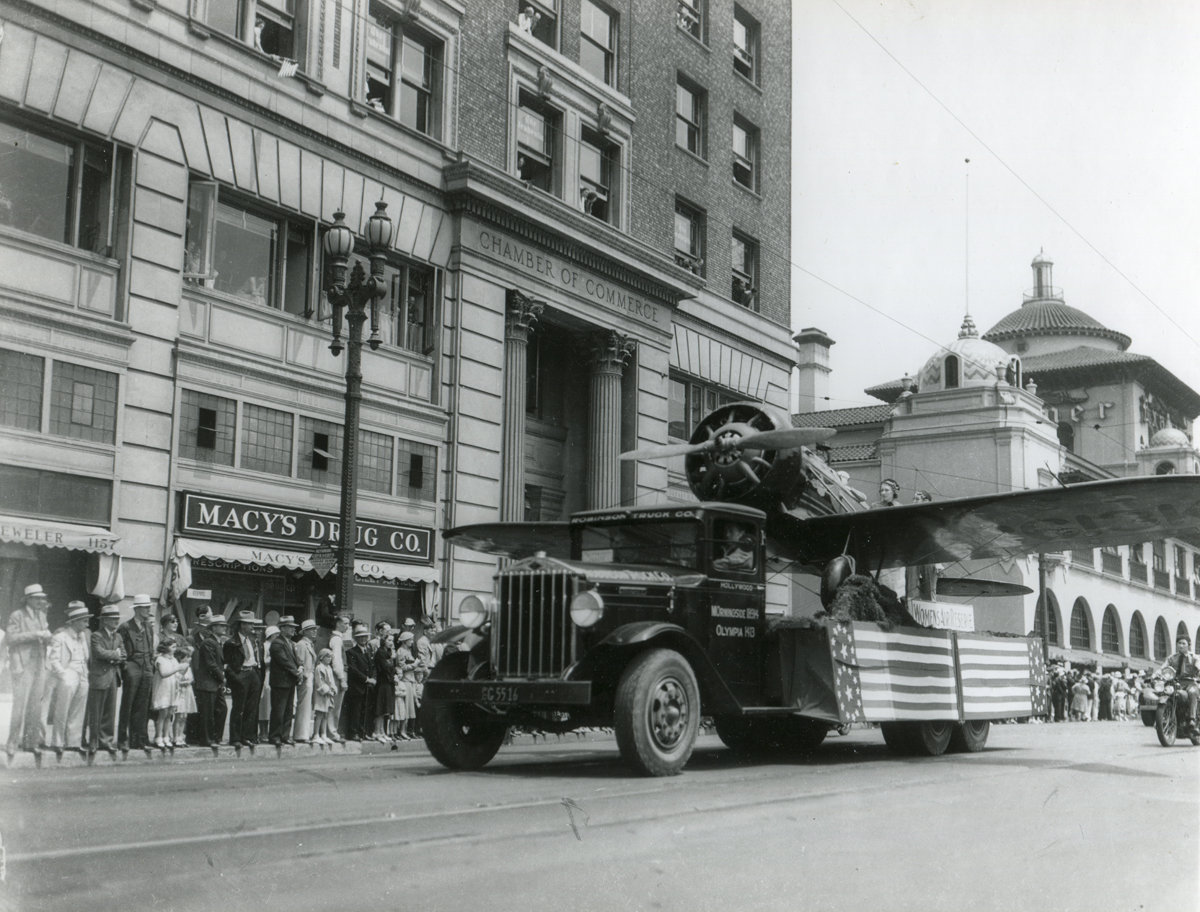
Last Friday, we posted the first photos from the recently-acquired William H. Alman collection. Today we continue drawing on this small-but-amazing set of previously unpublished images with today's first photo, which shows Pancho Barnes' Travel Air Model R, better known by its media-assigned name of "Mystery Ship", sitting on display next to Glendale's Grand Central Air Terminal.

The rest of the photos are original prints that come from the Mojave Transportation Museum collection.

Pancho's Mystery Ship on parade promoting the Women's Air Reserve. If anyone
knows the date of this parade, please comment below!
In the late 1920s, Walter Beech's Travel Air Co. of Wichita, Kansas was the world's largest aircraft manufacturer, and a powerhouse of aviation innovation, and produced a number of record-breaking and race-winning aircraft. In that era, records and trophies were one of the principal ways that aircraft companies promoted their products. On top of that, it was also an era when the US Army sent their best pilots to compete against civilians as contestants in various air races; typically, the Army would stay ahead of the civilians by using fighters with boosted engines, so they were typically the ones to beat.

Throughout the design and construction process, the Model R was a closely-guarded secret. First, Travel Air engineers Herb Rawdon (where the "R" in Model R came from) and Walter Burnham kept the project quiet from their boss until all the design details had been worked out, only ten weeks before the start of the 1929 National Air Races. Once Beech was briefed in, he enthusiastically endorsed the effort, as it showed potential for finally beating the Army at the Nationals.

Initially, Travel Air built two of the aircraft, one (Race 31, NR614K) powered by a 400 hp Wright J6-9 radial and the second (Race 32, NR613K) powered by an in-line 6-cylinder 165 hp Chevrolair D-6 engine (The Arthur Chevrolet Aviation Motors Corp was founded by Arthur, the brother of Louis Chevrolet, who stated the Chevrolet Motor Company, later part of GM). While these were under construction, a blanket of secrecy covered the factory, even to the extent that the building's windows were painted black. As a result, the very curious media (remember, air racing was a popular main-stream sport back then) dubbed the aircraft Travel Air's "Mystery Ships".

Once the aircaft were flown to Cleveland for the races, they were quickly tarped and reporters kept away. In the Thompson Trophy race, Doug Davis in #31 blew away the competition, the first time a civilian aircraft had won (mone on this in next week's post). Meanwhile Race #32 was also a winner at the 1929 Nationals, taking top place in the Experimental Class at 113.38 mph with Doug Davis again at the controls. After the races, the experimental Chevolair engine was removed and returned to the manufacturer, while the airframe was shipped back to Wichita, where it was modified to accommodate a Wright J6. It was then sold to Pancho Barnes.

Pancho used 613K to set a number of speed records, but the most famous of them was when she flew the aircraft over a closed-course at Van Nuys and shattered Women's speed record, previously held by Amelia Earhart, with a blazing 196.19 mph on August 5, 1930.

When her fortunes fell, Pancho sold 613K to Paul Mantz, who first used it in movie work, and then when it was no longer airworthy, displayed it at his Movieland of the Air museum. After Matnz' death, the plane was put up for auction, and when Pancho herself showed up to try to buy it back, she carried such respect from the aviation community that no one else was willing to bid against her. The Mystery Ship sat for years at Barnes Aviation's Lancaster CA hangar, slowly undergowing a restoration by Pancho's son Bill. When he was killed in a P-51 crash, the aircraft was again sold, this time to a collector in the UK, where for quite a while it once again became cloaked in secrecy while undergoing a pains-taking restoration, only recently reappearing, thanks to the efforts of Nick Spark, who produced the bio-pic The Legend of Pancho Barnes and the Happy Bottom Riding Club. An article on how he found the plane, along with some recent photos of it, can be found here.

A nice detailed history of the Mystery Ships can be found here.

Tuesday, September 18, 2012

Ready...Set...Go, Ladies, Go!

Ok, so I got carried away in writing this entry...it's the longest so far, but the story was so compelling!

The scene at Santa Monica's Clover Field for the start of the first Women's
National Air Derby on August 18, 1929. The aircraft in the center surrounded
by onlookers, with NC714N on its right wing, is Margaret Perry's Spartan C-3.
(Trivial sidenote...the truck at far right shows that the spelling "Naborhood"
was evidently acceptable in 1929.)
It all started with Lou Greve. This inventor, engineer and industrialist, who inherited the Cleveland Air Tool Company, was a major advocate of aviation. He invented the oleo-pneumatic landing gear shock absorber (under the name Aerol) that is used by virtually every aircraft flying today. To promote his company and his invention, Greve was a major sponsor of air racing in the late 1920s and 1930s, and was appointed as President of the company that organized the big races of that era, The National Air Races, Inc.

Greve was also a vocal advocate of allowing women (who at the time were largely viewed as inferior and even downright incompetent) to participate in air racing. For the 1929 National Air Races, to be held in Cleveland for the first time, Greve donated the trophy and purse for the first Cleveland Pneumatic Aerol Trophy Race, a two-class cross-country event to be held derby-style. It was to start in Santa Monica, California, at Clover Field, and end in Cleveland, Ohio. Over the years, the race has also become known as the 1929 Women’s Air Derby and the First Women’s National Air Derby.

With Phoebe Omlie's Monocoupe ready to go in the background, humorist 
and aviation promoter Will Rogers (third from right) talks things over with 
Ruth Elder. Could this have been that moment when he uttered his "powder-
puff" comment?
The Derby began on August 18, with a large crowd and a level of hoopla appropriate to such a major event. Our series of unique photos of the start of the race comes from the collection of Mojave Transportation Museum Board member and member of the Ninety-Nines, Cathy Hansen. The event would take place over eight days of stage racing, covering 2,200 miles, and include a lot of accidents and high drama, which was covered breathlessly by the contemporary media.

On the day of the race's start, many Southern California celebrities came out to see the competitors off, and one celebrity in particular was chosen to be the event's Grand Marshal, aviation promoter and nationally-known humorist Will Rogers. As the pilots made their final preparations to climb into their aircraft, he commented that their female “genes” compelled them to take one final look at the mirror in their compacts, and apply one final dab of powder to their noses (some of the racers later would comment that it was Ruth Elder who was especially prone to this habit). With reporters standing around, he quipped, “Looks like a powder puff derby, to me.” The phrase was grabbed and repeated across the continent by the media, to the point that after the Women’s National Air Derbies were resumed in 1947 (they ran through 1977), they were officially known as “The Powder Puff Derby”.

Close-up from the above image, showing Will Rogers
conversing with Ruth Elder.
The race was divided into two classes, based on engine size (women were being allowed to race airplanes with power “appropriate” to their gender, according to the male race organizers; as such, for instance, Opal Kunz was disallowed to fly her own 300hp Travel Air, because it was thought to be too much airplane for a woman, so she had to borrow one with less power) – Class C, which had six competitors, was for aircraft with engines between 275 and 509 cubic inches, and Class D, with 14 entrants, was for 510 to 800 cubic inches.

Twenty women in all started the race, 18 from the U.S. and one each from Australia (Jessie Keith-Miller) and Germany (Thea Rasche); to put it in contrast, there were only 100 women (some sources say 70) who held pilots licenses in America at that time, so nearly a fifth of them participated in this race (at that time, there was no FAA to issue licenses, instead they were issued by the French-based Fédération Aéronautique Internationale, or FAI, the organization that still to this day sactions and authenticates all world aviation records). Among the entrants was Amelia Earhart in her first competitive race, and the flamboyant Pancho Barnes. The rules stated that each entrant had to have at least 100 hours of flying time, including at least 25 hours of cross-country experience. The racers, and their aircraft, were:

Class C


Class D


Edith Foltz (#109)
Jessie Keith-Miller (#43)
Clair Fahey (#54)
Phoebe Omlie (#8)
Thea Rasche (#61)

Bobbi Trout (#100)

Alexander Eaglerock
Fleet
Travel Air (OX-5)
Monocoupe
deHavilland Gypsy Moth
Golden Eagle Chief

Pancho Barnes (#2)
Marvel Crosson (#1)
Amelia Earhart (#6)
Ruth Elder (#66)
Mary Haizlip (#76)
Ruth Nichols (#16)
Blanche Noyes (#3)
Gladys O'Donnell (#105)
Margaret Perry (#11)
Louise Thaden (#4)
Mary von Mach (#5)
Vera Dawn Walker (#113)
Neva Paris (#23)
Opal Kunz (#18)

Travel Air
Travel Air
Lockheed Vega
Laird Swallow
American Eagle
Rearwin Ken-Royce
Travel Air
WACO
Spartan C-3
Travel Air
Travel Air
Curtiss Robin C-1

Curtiss Robin
Travel Air

Vera Dawn Walker, a native of Los Angeles, named her Curtiss Robin C-1 Miss 
Los Angeles. Here she gets the start flag.
Of the twenty entrants, only 19 started together on August 18. Nineteen-year-old Mary Haizlip's plane had been damaged on the trip to Santa Monica, and so she had to quickly find a replacement, delaying her departure. And she wasn’t the only one that had trouble just getting to the starting line. Louise Thaden, flying a Wright-powered Travel Air, fought the effects of carbon monoxide poisoning from her engine's exhaust, leading Travel Air president Walter Beech, who was sponsoring her and following her out to California, to order some immediate modifications to her plane in order to provide fresh air in the cockpit.

On her way to Santa Monica, Phoebe Omlie had to make an off-airport landing, and was arrested and jailed by the local cops as a suspected dope smuggler. It was only when Amelia Earhart, Louise Thaden and Marvel Crosson showed up at the sheriff's office to vouch for her that the law decided that they had the wrong person.

The race was started according to class, with the airplanes lined up abreast and individually flagged to take off when the timers were ready. The initial gun-shot starting the race was fired in Cleveland, and transmitted by radio to Santa Monica.

With a wave of the flag, Thea Rasche taxis her deHaviland Gypsy Moth
across the start line. She would finish fourth and last in the light division.
Day 1, August 18, Santa Monica to San Bernardino: A series of minor incidents gave a glimpse of what was to come. Before the start, mechanics had mistakenly filled Ruth Elder’s fuel tanks with oil, which then had to be drained and purged. Earhart had to return to Clover after takeoff for a stuck starter, and at San Bernardino, there was so much dust on the field from the aircraft before her that she landed long and almost ran into the large crowd of spectators. Opal Kunz, also with dust visibility problems, landed hard and damaged her plane’s landing gear. The flyers were treated to a lavish banquet and partied into the night, a habit that was continued throughout the race, leading to sleep deprivation problems.

Day 2, August 19, San Bernardino to Yuma to Phoenix: Claire Fahy, flying a Travel Air, had to make an emergency landing in Calexico because of broken flying wires, the bracings that held the bi-planes wings in shape. Rumors of sabotage had run rife before the race started (Edler’s fuel tank problems didn’t help this, either), and Fahy cried foul, alleging that her wires had been eaten away by acid in a deliberate attempt to cause her to crash. Thea Rasche had to make an off-airport landing when her engine quit, and found contamination throughout her fuel lines. Amelia’s Vega nosed over at Yuma, damaging the prop, and she was stuck there until a new one could be flown out later in the day. Mary Haizlip, Pancho Barnes and Bobbi Trout got lost and ended up in Mexico, but Trout’s problem was more serious than the others: she was out of gas and had landed in a soft dirt field, badly damaging her Golden Eagle. Some friendly locals helped her move the airplane across the border to Yuma’s airport, where it took three days to rebuild, putting her far behind. Sixteen aircraft arrived at Phoenix, and three of the other four were accounted for. Pancho was in first place in the heavy division, with Phoebe in first in the light.

Marvel Crosson, however, was missing. The next morning, her Travel Air was found destroyed in the rough territory of the Gila River Valley, four miles from Wellton, Az. She had crashed only twenty minutes from Yuma. Some of the media reports at the time claimed that she had bailed out and her chute failed to open, while others said that she was thrown from the plane on impact. Her body was found a couple hundred yards from the plane, with her partially deployed chute. There was evidence that she had vomited over the side of the cockpit, a typical symptom of carbon monoxide poisoning. For her to do that, she would have had to unbuckle and raise herself up off her seat in order to lean out over the cockpit rim. It would have been difficult for her to keep her hands on the controls at this point. Whether it was at this moment or whether she lost consciousness a short time later, she clearly lost control of the aircraft. Four witnesses (ranchers, who had no first-hand knowledge of piloting an aircraft) recounted that they had seen the plane spinning and diving at high speed. Virtually every bone in Marvel's body was broken, and she appeared to have died instantly. Her loss stunned the racers and the public who were following in the media. The media frenzy, of course, went into overdrive, with calls for the race to be cancelled, and allegations that this was “proof” that women had no business trying to fly. The racers, though, decided to carry on with the competition, knowing that Marvel would not have wanted her loss to result in the cancellation of the competition. Mary von Mach, in rallying her companions, declared, "Our pain shall become her tribute."

Day 3, August 20, Phoenix to Douglas: The women had to navigate the vast emptiness of the Arizona desert with nothing but a crude map and a bouncy, unreliable compass. Walker attempted to follow the railroad tracks out of Tucson, but picked the wrong set, and ended up far north of course, costing valuable time as she had to backtrack. In doing so, she also got caught up in a potentially fatal thunder storm. Her Monocoupe's enclosed cabin shielded her from the direct effects of the storm, and the altitude which she was at save her from hitting the ground when she became disoriented and lost control in the midst of the storm's violence. She landed in a cow pasture, only to meet up with some local men who were accompanying Jessie Keith-Miller, who had also made a forced landing. Others had to land as well: Opal Kunz ran out of gas, and Blanche Noyes landed near a farm house to try to find out where she was, only to discover that everyone there spoke only Spanish...because she was in Mexico. Pancho did the same thing.

By the time that the racers were in Douglas, Crosson's death was confirmed. Thaden strongly suspected the carbon monoxide poisoning that she herself had experienced in the Travel Air on the way to Santa Monica, and became concerned for the other racers flying that type.

Day 4, August 21, Douglas to El Paso to Midland: Pancho’s south-of-the-border detour the day before resulted in a big “MEXICO OR BUST” painted on the side of her Travel Air.  The racers ended up stopping for the day in El Paso, which had been intended as a fuel stop only, as a dust storm between there and Midland precluded any further flying. The high winds naturally were directly across the runway, exceeding the crosswind limits of some of the planes, and making for very challenging landings. Louise Thaden and Phoebe Omlie were in the lead of their respective divisions. Since this was an unplanned overnight stop, there were no banquets to consume precious sleep time.

Day 5, August 22, El Paso to Pecos, Midland, Abilene and finally to Fort Worth: Blanche Noyes’ troubles continued, with a fire in her small baggage hold. She landed in the desert, pulled the smoldering, wooden floor out and put the fire out with sand. In the process, her landing gear was damaged and she had to stop and have it temporarily welded. Airports weren’t the same back then, and there was so much publicity about the event, that in Pecos, like other places, the crowds just drove out onto the designated landing field to get a closer look. Pancho Barnes’ Travel Air, like most big-engined tail-draggers then and now, had just about zero forward visibility in the landing attitude. As such, she hit a car as she was touching down, destroying her plane. Although Pancho herself was not hurt, there would be no more racing this year for her. Margaret Perry, flying a Spartan C-3, landed at Abilene, unable to go on, and was taken to the hospital with Typhoid fever. Continuing fears of carbon monoxide poisoning plagued the Travel Air pilots, and Walter Beech instructed mechanics from Travel Air to hurry to Fort Worth and modify all the remaining Travel Airs to prevent any further problems. Thaden was in first place in the heavies (by 21 minutes), and Omlie in first in the light division. Though some of the racers were hopelessly behind, the pressed on, if only to prove that they could complete the race.

Claire Fahy in her Travel Air gets the start flag. Because her Travel Air was powered by
a 90-hp in-line OX-5 engine, rather than the larger Wright J-5 radial, she raced in the
light class. She would only make it as far as Calexico before failed flying wires caused
an emergency landing, putting her out of the running. Of note is the fourth airplane in
the lineup, Edith Folitz' Alexander Eaglerock Bullet, the only low wing monoplane in
the field, and the only one with retractable landing gear. Folitz came in second in the
light division.
Day 6, August 23, Fort Worth to Wichita: Mary Haizlip had to land twice due to oil line contamination, and Vera Dawn Walker (who was only 4’11”, and had to use pillows to be able to reach the rudder pedals) had to land her Curtiss Robin for engine overheating. Ruth Elder lost her precious map over the side of the cockpit, and had to guess at her course. Although they were now over a region where property lines and roads followed regular section lines, making navigation a bit easier, smoke from wildfires made visibility difficult, and Elder realized she'd drifted off-course (all towns looked pretty much the same, without a map to provide detail clues). She landed to find out where she was (Muskogee, OK, east of her course) but to make the ensuing takeoff, she first had to single-handedly chase away an uncaring herd of cows. Since Wichita was the home of the Travel Air company, the airplane chosen by a third of the participants, a crowd of at least 10,000 gathered to see the racers land.

Day 7, August 24, Wichita to Kansas City to East St. Louis: Thaden's race-leading performance had garnered much positive publicity for Travel Air, so Walter Beech approached her and offered to let her race their newest aircraft, the Model R - otherwise known as the Mystery Ship - in the Cleveland races. With that to look forward to, Thaden pressed on. Gladys O'Donnell's right main gear sunk into the soft sod on takeoff, causing her to nose over. A quick field repair to the dinged prop got her back in the air in short order, however. The media had a difficult time knowing how to handle the event. Some "news" stories were downright critical of the women and said that the stunt did nothing to further promote aviation in a legitimate way. Other reporters chose to focus on the fashion statements and general appearances of the women, something that they'd never do if it had been a male-only race. The women themselves, though, were unfazed, and started making plans to meet under the bleachers in Cleveland, to cement the relations they had built into a lasting organization to promote women in aviation. The destination, the airfield of Parks Air College in St. Louis, had a difficult approach with wires and trees at both ends, necessitating a sideslip approach on final. Both Blanche Noyes and Neva Paris ended up having to deliberately ground-loop in order to avoid running off the end of the runway, damaging the landing gear on their planes, but once again, field repairs had things in order before the next morning's takeoff.

Day 8, August 25, East St. Louis to Terre Haute, Cincinnati and Columbus: The Cleveland Aeronautical Exposition was opening this Sunday, and the excitement was growing about the arrival of the women, due in on Monday. The thick fog of early morning did nothing to dampen the spirits as the racers prepared for departure. Mary Haizlip's fuel contamination problems had continued, and so far in the race, she had made six emergency landings. Now, she had all the fuel lines completely drained and flushed, revealing quite a bit of foreign debris. To make matters worse, a mechanic working for Travel Air who was assigned to care for that company's planes in the race, reported that someone had tampered with Louise Thaden's magneto points. To forestall any further acts of sabotage to the race leader, he decided to sleep with the aircraft that night in Columbus. Bobbi Trout was catching up, and arrived at Parks just after the other racers had departed. Though she was no longer being officially timed, she quickly refueled and took off again, on her hunt to make up time. As the racers arrived at Lunken Airport in Cincinnati, they were greeted by a crowd twice as large as that which had turned out for Charles Lindbergh only two years before. Edith Foltz couldn't find the field, so pressed on to Columbus untimed. Meanwhile, Trout's problems continued, with engine failure. She barely was able to glide into an almost-too-small field, sideslipping between a line of poplar trees. She ground looped in an attempt to avoid a fence, but ripped open her aileron anyway. A tin can provided handy repair material, while an electrician from a nearby town managed to get her engine running again, and she was quickly back in the air. As an example of the excitement that the general public felt about the race, a local farmer between Cincinnati and Columbus plowed a giant arrow in to his field to help the racers along.

Day 9, August 26, Columbus to Cleveland: The final leg of the race was a mere 120 miles. Columbus had a new concrete runway that was still partially under construction, and the night before, the racers whose airplanes had metal tail skids (useful on sod runways) instead of tail wheels had caused a bit of a stir when the skids kicked up showers of sparks. The edges of the runway hadn't been finished, yet, leading to problems during the takeoff. Ruth Nichols, who sat comfortably in third place, had some work done on her Rearwin overnight, and so got up early to fly a brief test hop. On returning, she did not heed the warning to stay in the center of the new runway, and her plane clipped a tractor parked next to it, crashing. While she "miraculously" survived the wreck, she was out of the race. All the previous race takeoffs had taken place in reverse order of the standings, but from Columbus, the women left at one-minute intervals in the order that they held from the night before. Louise Thaden took off first, and after a 54-minute flight, spotted the Cleveland airfield, diving for the finish line, and crossing it at 170 mph. Her average speed for the race was 135.97 mph, and her total time was 20 hours, 2 minutes. As the winner of the heavy division, she also thus garnered the majority of the media attention. Addressing the crowd, Thaden said, "The sunburn derby is over, and I happen to come in first place. I'm sorry we all couldn't come in first, because they all deserve it as much as I. They're all great flyers." She dedicated her win to Crosson, and told the media that she was going to send the trophy to Marvel's family.

Second place went to Gladys O’Donnell (WACO 10, #105; 127.52mph, 20h:43m), third to Amelia Earhart (122.64mph, 22h:12m), with Blanche Noyes (Travel Air, #3; 110.88mph) in fourth and fifth went to Ruth Elder (Laird Swallow #66; 96.41mph)

In the light aircraft, or C Class, Phoebe Omlie took first place (Monocoupe #8; 108.19mph), Edith Foltz (Alexander Eaglerock Bullet #109; 65.44mph) came in second, followed by Jessie Keith-Miller (Fleet Model 2, #43; 51.98mph) with Thea Rasche (deHavilland Gypsy Moth, #61; 42.17mph) in fourth. Bobbi Trout finished the race technically in fifth place, although her time was not recorded.

Soon after the race, Louise Thaden, Amelia Earhart and Ruth Nichols met under the grandstand and together founded the Ninety-Nines, a women's aviation organization that is still active today.

There’s a tremendous amount of information that has been written about the 1929 race over the years, and this blog entry has really just barely scratched the surface. If you’d like to read more, here are a few sources to check out:
-A very detailed article by Gene Nora Jessen on the Ninety-Nines’ website. Jessen also has written an excellent book about the event, The Powder Puff Derby of 1929, which can be ordered here. This book is a wonderful read, and a big shout-out goes to Gene for taking the time to correspond with me, and for all her help in putting this piece together.
-Coverage on the Pancho Barnes history website, including a lot of contemporary media coverage
-Cleveland State University's web page on the history of Cleveland Airport
-A movie has been made about the race, and is available on DVD, and the movie's website has a wealth of information as well.

Friday, August 17, 2012

Los Angeles to Tokyo, the Hard Way

Zensaku Azuma in his Travel Air 4000, presumably in Japan. The hand-written
text translates roughly "Mr. Zensaku Higasihi 'Tokyo OT' likes this small
airplane very much," with "Tokyo OT" referring to text painted on the
airplane itself. The last line, on the far left, seems to indicate the name of the
airport, but it isn't clear.
Back in December, in my blog post commemorating the Voyager's round-the-world flight, I noted that Dick Rutan's clearance request on takeoff asked for "Edwards to Edwards, the hard way." He wasn't the only one to think in traveling from one place to another "the hard way."

Japanese-American aviator Zensaku Azuma (1893-1967) had that idea as well. In the words of the Indiana Evening Gazette for Wednesday, June 25, 1930, "Evidently the Oriental mind reasons that 'the longest way around is the shortest way home,' so Zensaku Azuma, a Pasadena, Calif, chop suey restauranteur (a Japanese, nevertheless) plans to fly from California to Tokio via New York, Paris, Berlin, Moscow, Siberia, China and Korea. The trip across the Atlantic would be made by steamship, the rest by air."

Azuma was born in Minami-Omi, Hakui County, Ishikawa (what is now known as either Nakanuma or Takamatsu - depending on the Japanese source - in Kahoku), and as a young newspaper reporter in Japan, had reported on some of the earliest aircraft, and found himself attracted to aviation. Wanting to learn to fly, he traveled to the US in 1916, at the age of 23, and earned his pilots license by 1922. He also earned a reputation for being somewhat flamboyant. In 1923, after the Great Kanto earthquake in Japan, Azuma painted "Help Japan" in large letters on a biplane and barnstormed in an effort to raise relief funds.

To earn a living, Azuma opened a Chinese restaurant (a "chop suey house" in the parlance of the age) in Pasadena. When Lindbergh made his historic flight in 1927, it inspired Azuma, who considered a similar "stunt" as a means of visiting his homeland. The feat earned him the nickname "the Japanese Lindbergh" in contemporary media.

Meanwhile, Travel Air 4000 NC4835, serial 419, first shows up in the records, as an entry dated April 30, 1928 in the register from the old Davis-Monthan Airfield, when it was flown by Santa Barbara orthodontist Dr. J. Bert Saxby, on a trip from El Paso, TX to Santa Barbara. Before Dr. Saxby acquired the plane, it apparently had been owned by cowboy actor, rodeo star and stunt pilot Ken Maynard. (As an aside, after owning the Travel Air, Maynard bought a Steaman, and at the 1933 National Air Races, he flew it in a grudge race against actor Hoot Gibson. Rounding one of the pylons, Maynard crashed, and while he survived, his airplane was destroyed).

Azuma purchased the Travel Air in April 1930, and had it modified from a typical two-seat configuration to a single seater, with the rest of the space being used for additional fuel tankage for the flight to Japan. As such, it was re-registered in the restricted category as NR4835. Then, from June through August 1930, he fulfulled his dream and flew the Travel Air across three continents enroute to Japan. He first across the U.S. from Los Angeles to New York, before having the plane disassembled and loaded onto a steamship for the voyage to England. There, he had the aircraft reassembled in Hanworth by National Flying Services, Ltd. He repositioned from Hanworth to Croydon and then left for the trip east on July 22.

After spending the night of August 30th in Seole, Azuma finally landed at about 5:22 pm (local) on Saturday, August 31, 1930, at Tokyo's Tachikawa Aviation Grounds, where he and the City of Tokyo were greeted by a large crowd. All tolled, Azuma logged 70 flying days and over 11,200 miles during his journey. He was celebrated as both a local and a national aviation hero, and was even presented with a "trophy" by the Japanese Emperor.

Buoyed by success, Azuma began planning and attempting to raise funds for a one-stop California to Japan trans-Pacific flight, but it does not appear that he never actually attempted the flight. Years later, in 1955, Azuma once again entered the spotlight of history as the first person to discover the mineral uranium in Japan, and became a vocal proponent of the "health benefits" of uranium - going so far as to plant a "uranium garden" from which he harvested and ate vegetables.

With the growing militaristic nature of Japanese society in the 1930s, the City of Tokyo wound up in the hands of the Japanese Army, but since it was clear that the Travel Air 4000 was by no means a combat-worthy aircraft, they disposed of it. It was subsequently re-registered as J-BAOJ; old registration records show the ownership as being Nippon Demppo Tsunshin, while other records identify the owner as Nippon Denjo Communications Company, which today is known as Dentsu.

This organization apparently acquired the aircraft in November 1931 as a result of the Manchurian incident, in which a Japanese-instigated act of sabotage was used as a pretext for the wholesale invasion of the Chinese region of Manchuria. The Travel Air was used in China to transport news reports and photographs of the fighting. When the Japanese established the puppet state of Manchukuo in March 1932 in the territory which they occupied, they mounted a showy Declaration of Independence ceremony. News photos of the ceremony were being flown out in the Travel Air when the aircraft was severely damaged at Ulsan air base near Pusan. There is no record of it being repaired.

There is one really good photo of the Tokyo on the internet, at the Japanese Aeronautic Association website (the page is in Japanese, but if you open it with Google Chrome, you'll get a machine translation of it).

In Zensaku's hometown, there is a monument to him, and the town annually hosts a paper airplane contest in his honor. With that in mind, as a small footnote to the story, the City of Tokyo shows up on a paper model airplane hobbyist website as a downloadable plan...and apparently it was painted red.

(Huge nod to Ann A., Jayne and her mom for the translation of the handwriting on the photo!)