Showing posts with label Howard Hughes. Show all posts

Friday, September 27, 2013

An American Messerschmitt

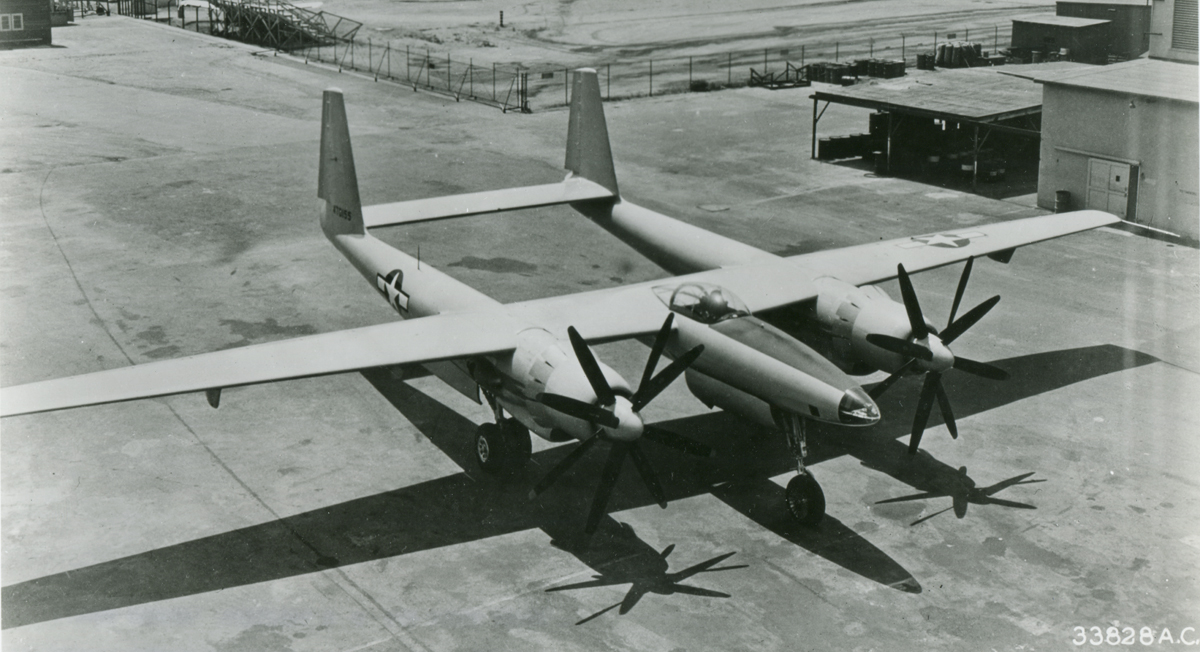
The location for this photo appears to be Hughes Aircraft at Culver City. The
Archive's copy is a recent reprint on modern photo paper, unfortunately, but
when I found it at a Burbank antique store, I couldn't pass it up.
The Messerschmitt ME-262 was a legendary aircraft, the world's first operational fighter jet, and over 1,400 were built during WWII. One of the most "storied" of the eight surviving aircraft is the subject of the two unrelated photos being featured today. Before the end of the war, the Army Air Forces had put together a small organization called the Air Technical Intelligence (ATI) division, which was tasked with finding and securing examples of Nazi advanced technology which could then be studied, tested and exploited. After the war, one of the key targets of ATI was the ME-262 jet fighter, which had so out-classed its Allied adversaries.

Eleven ME-262s were returned to flight status at Lechfeld, Germany and ten were ferried back (one had crashed during a test flight) to the US onboard the British carrier HMS Reaper. This group of ten were split between the US Navy and Army Air Forces, and became (unoffically, of course), America's first jet fighter squadron. A very detailed article about the unit and the men that brought these captured planes home, who collectively became known as "Watson's Whizzers", can be found here.

While stored at Chino in the early 1960s.
Of the five AAF ME-262s, one was lost in a landing accident, but the other four have survived to this day, including the one shown in our two photos. It started out as a ME-262A-1a/U3 (WkNr. 500453) unarmed reconnaissance variant. When first recovered by the Americans, it was named Connie...the Sharp Article and then a bit later Pick II. After arriving at Newark on the Reaper on 1 August 1945, the squadron was ferried to a small, little-known airport call Freeman Field in Indiana on 19 August, where the planes were put through their paces and their capabilities were explored. The testing was coordiated by T-2 at Wright Field. Our plane received the designation FE-4012 when it arrived in the US (FE=Foreign Equipment), and once the testing got underway, this was changed to T-2-4012.

One set of flight tests was aimed at evaluating the ME-262's capabilities against America's top operational fighter, the Lockheed P-80 Shooting Star. Messerschmitt had designed and assembled the ME-262 as a modular aircraft, so it was easy to change a plane's confirguration. For this series of evaluation flights, the American crew removed 4012's reconnaissance nose and replaced it with an aerodynamically cleaner fighter nose, sealed the gun ports, and gave the plane a new gloss paint job. On 17 May 1946, the plane was ferried to Patterson Field (at the time, the field's management had not yet been merged with nearby Wilbur Wright Field) where the testing was to be based. A total of eight flights were flown, two of which resulted in emergency landings. The engines were proving to be extremely unreliable, and after only 4 hours and 40 minutes of testing - and four engine changes! - the testing was called off in August of that year.

Despite the fact that (at least by modern flight test data acquisition standards) this was hardly enough flight time to gather an abundance of reliable flight test data, the Army concluded that the ME-262 had better accelleration and top speed, while showing about the same climb performance as compared to the P-80. The ME-262 also appeared to have a much higher critical Mach number, meaning that it had much less high-speed drag and better performance in the transonic realm.

After the AAF completed the flight testing, the aircraft was disassembled and shipped to Hughes Aircraft in Culver City for storage. There the plane was reassembled and the engines were ground-run, but the plane wasn't flown. Rumors have persisted over the years (and have been amplified on the internet) that there was a desire on the part of Howard Hughes to fine tune 4012 and enter it in a Thompson Trophy race against the AAF's P-80. The conspiracy-theory type rumors state that this effort was squashed by General Hap Arnold as part of a "cover-up" because he didn't want an old Nazi war machine showing up America's newest weapon.

However, despite the persistence of this story, there appears to be no factual basis for it, and when one looks at the details, the improbability of it all really stands out, even given the well-known animosity between Arnold and Hughes. First and foremost, if anyone could make the ME-262 fly reliably, it was Watson's Whizzers, who had access to plenty of spare parts as well as German expertise; Hughes might have had money, but he had none of this. Even with all those resources, the aspect that stands out most from the plane's testing was the terrible reliability of the Jumo 004 engines, which would have been wholly unsuited for air racing. On top of the practicality issues, the timing of it all just doesn't fit. The stories never really indicate which Thompson Trophy race the plane was to be entered in, but there were only three that were possibilities, the 1946, '47 and '48 races.

In the time leading up to the 1946 race (held from 29 August through 3 September), the plane was still in the hands of the AAF at Patterson, Hughes was in the hospital recovering from the near-fatal crash of the XF-11, and most importantly, Hap Arnold had just retired, and so was out of the picture in regards to any official coverup. By the 1948 races, the new North American F-86, which could fly circles around the P-80 (by then, F-80), had been in development flight test for a year, and so had made any grudge match a moot point; the races that year were dominated by the Navy's FJ Fury, and the P-80 didn't even appear.

That leaves the 1947 races, but Hap Arnold was still out if the picture in retirement, Hughes was neck-deep in preparations for both the H-4 (aka Spruce Goose) first flight...in fact he was so focused on this project that once made the statement that if the H-4 Hercules didn't fly, he'd up and leave the country for good. In addition, Hughes had the task of preparing for and testifying at the contentious hearings of the Senate War Investigating Committee. While 4012 was stored at Hughes' Culver City facility, it was still government property, and thus couldn't just be used for any personal racing whims that an otherwise swamped Hughes might have. So, barring some heretofore unknown hard evidence that Hughes proposed such a project, the story should be regarded as just one more Hughes-related rumor.

After a short time in storage at Hughes, it became clear to the leadership of the new USAF that our own technology was already far ahead of where the Nazis had been a few years earlier, and there was nothing to be gained in further testing of the ME-262. Thus, the aircraft was given to Cal Aero Technical Institute at the Glendale airport, where it was used as a hands-on teaching tool for student aircraft mechanics.

In about 1955, the plane was acquired by Edward Maloney for his Planes of Fame collection, and was partially restored, and statically displayed incorrectly as WkNr 111617 at the Chino museum. In about 2000, ex-Microsoft executive Paul G. Allen purchased the plane for his Flying Heritage Collection, located at Paine Field in Washington. According to some reports, it was shipped to the UK for restoration, but has since returned to the US, where it is reportedly being completed to flying condition, to be powered a pair of original Jumo engines. The aircraft has been registered with the FAA as N94503, with ownership being listed as Vulcan Warbirds, Inc., one of Allen's companies.

Friday, March 29, 2013

The Incredible Saga of Igor's Gotha

Sometimes, the process of researching these photos takes me on an amazing journey. When I was offered the snapshot below, it was described as an "unknown" aircraft. As soon as I received it though, I realized that this was an early view of a remarkable plane that was represented, later in its life, in our Glendale negative collection. I had already started researching the latter photo, and now to have two images acting as bookends made the story even more compelling to me. As the research uncovered the details, though, the tale seemed more like an improbable Hollywood saga rather than a real part of aviation history...but then again, it's these fantastic stories that make aviation history so much fun to be a part of! 

Within 24 hours of hearing about the accomplishments of the Wright Brothers, young Igor Sikorsky was convinced that aviation was the future and he wanted to be a part of it, and thus changed his entire life's plans to become an aeronautical engineer. However, in post-WWI Europe, with its cities decimated by war, and especially in his native Russia, the prospects for such engineers looked grim. So, he emigrated to America and began looking for opportunities, and raising funds from fellow Russian emigres to start building planes.

Was there something in the grass that day? Kids on both the extreme left
and right of the photo are lifting their legs in odd ways...
Igor's first design under the auspices of the Sikorsky Aero Engineering Corporation was a twin-engined sixteen-passenger airliner, which he designated S-29-A (the "A" to celebrate that this was his first design in America). Construction was started with meager resources.

According to an article from the November 2002 issue of Air & Spacearchived at the Sikorsky corporate web site, Igor set up shop on a "chicken farm owned by his friend Victor Utgoff, a former lieutenant in the Russian navy. The work had to be done by hand, since the farm did not have appropriate machinery. Sikorsky and his workers, mostly Russian immigrants, were raiding junkyards for parts for the airplane, which had to be constantly redesigned depending on the equipment and materials they found. The main structure of the fuselage was built with angle irons from discarded bedsteads. Turnbuckles, which were used to adjust wire tension, were found in a Woolworth’s five-and-dime. The landing gear was installed with the help of Sikorsky’s nephew, Dmitry (Jimmy) Viner, who was a ditch digger. 'Since there was no jack to raise the fuselage,' Frank Delear wrote in Igor Sikorsky: His Three Careers in Aviation, 'Jimmy dug under it to make space for the wheels and landing struts. With the gear installed, the plane was then pulled out of the ditch.'"

The Air & Space article also describes what saved the project: "One Sunday, a chauffeur-driven limousine drove up to the chicken house. A tall, slender figure in a long black coat stepped out of the car and walked up to the airplane. In total silence, he inspected the aircraft. 'Everyone on the farm got greatly excited,' says Sergei Sikorsky, Igor’s son and the retired vice president of Sikorsky Aircraft, who remembers well how his father described the event. 'They all immediately recognized Sergei Rachmaninoff as their guest. My father went up to him and they began to talk. After about a half-hour visit, Rachmaninoff said, "I believe in you and your plane and I want to help you.”' The composer sat down and wrote a check for $5,000. With a smile, he gave the check to the stunned Sikorsky and said, 'Pay me back whenever you can.'" As a return favor, Sikorsky offered Rachmaninoff a VP position in the fledgling company, and the two remained close there after.

The S-29-A had two first flights. The first first took place on May 4, 1924, with the plane equipped with two 220hp Hisso engines, which left it underpowered. Igor himself was at the controls, and after lifting from Roosevelt field, he coaxed the floundering plane to Mitchel Field, where it crash landed. The plane was was not too badly damaged, and was rebuilt, with the engines being replaced by a pair of 400hp Liberty 12s. The second "real" first flight (as recognized today by the Sikorsky company) took place on September 25, 1924. With the larger engines, the S-29-A was the first twin engined aircraft in history that could safely continue flying on only one engine. It was too soon, though...the airline industry was still in its infancy, and America wasn't ready for an airliner of that size yet. While the airplane drew many an onlooker wherever it landed (as can be seen in our first photo of it, above), no customers stepped up and ordered the type.

Instead, it found a number of short-term uses. Sikorsky's first profit with the plane came, ironically, on April 23, 1925 when it was chartered to carry two grand pianos, one of which was delivered to the wife of the President. (Here, by the way, is an interesting conflict in the historical narrative: The official history of Sikorsky Aircraft says that the piano was delivered to President Herbert Hoover's wife, whereas contemporary newspaper accounts at the time said that it was delivered to Mrs. Calvin Coolidge. I'm inclinded to believe the accounts of the day!).  The Davis-Monthan Aviation Field Register web site has an extensive article on the details of the plane's life, which includes some photos from the Library of Congress showing the pianos being unloaded.

A few weeks later, on May 8th, 1925, the airplane received a name, Yorktown, and a christening (with a bottle of water, since it was the era of Prohibition), and then the next day it started airline service between New York and Yorktown, VA, as reported by the Washington Post. What isn't clear, though, is who operated the service, how long it lasted, and how it was received.

The plane is next seen being used as a flying billboard for Curlee Clothing in a business arrangement orchestrated by the flamboyant barnstormer Roscoe Turner. Eventually, when the Department of Commerce began registering aircraft in 1927, the S-29-A was assigned registration number NC-2756. Also in 1927, Turner bought the aircraft and contracted with United Cigar Stores to turn the large plane into, as was emplazoned on the side, the "First Flying United Cigar Store". The plane would fly from town to town, attracting large crowds, who then (everyone involved hoped) would buy cigars from the salesmen onboard.

Anyone recognize the gent standing in front of the plane?
Finally, Roscoe Turner sold the S-29-A on April 3, 1928 to the Caddo Company, of which Howard Hughes was president. He added it to the private air force he was assemblying to be used in filming the epic Hell's Angels. In preparation, the aircraft was heavily modified in order to play the part of a German Gotha bomber. Our second photo is one that comes from the unique collection of Glendale-related negatives which the Archive owns, and shows the modified aircraft on the production set at Glendale.

In the plane's intended final scene, shot above Pacoima, CA on March 22, 1929, it was supposed to appear to have been shot up, giving off fake smoke, and then spin and crash - Hughes himself insisted on the spin, for visual effect. Most of the stunt pilots working the production refused to fly the plane, as they believed that the modifications compromised its safety. Famed stunt pilot Al Wilson volunteered to do the flight - for the handsome sum of $10,000 - but he also recognized the dangers involved, and insisted on flying alone. The scene called for "lamp black" to be released during flight to simulate the smoke, and mechanic Phil Jones convinced the director to overrule Wilson and permit him to fly along to release the smoke.

The fears about the aircraft's safety proved to be true, and as soon as Wilson entered the spin, the plane began to come apart. Wilson yelled to Jones twice to bail out, and then he himself "hit the silk". However, for some unknown reason, Jones failed to exit the plane, and was found dead in the wreckage, still at his station. The impact of the tragedy hit Wilson hard. Although he was eventually exonerated of any culpability, many blamed him for Jones' death, and he gave up movie flying, instead taking a position as an airline pilot with Maddux Airlines.

Tuesday, January 29, 2013

Portrait of the XF-11

Towards the end of WWII, the Army Air Forces decided that they needed a new high-speed, long-range photo reconnaissance aircraft, and so a competition ensued between Republic’s XF-12 Rainbow and the Hughes XF-11 (Hughes apparently didn’t give a name to his design). As I’ve mentioned before in the post (here) on the XR-12, the competition and the aircraft are covered in detail in Mike Machat’s book World's Fastest Four-Engine Piston-Powered Aircraft: Story of the Republic XR-12 Rainbow.

Because the first of the two XF-11 prototypes crashed – and almost killed Howard – during its maiden flight on July 7, 1946, Machat comments that “Any photograph of the first XF-11 should be considered rare.”
So I was delighted when the Archive had the opportunity to acquire an original Air Force print of the aircraft, taken during an official “portrait” session with the aircraft, when the plane was posed and shot from all angles on the ramp at Hughes Aircraft. The back of the 8x10 glossy is stamped, in blue ink, “Hughes XF-11 3/4 front view on ground. Please credit: Official U.S. Air Force Photo” (which indicates that the print was made after the USAF became a separate service in 1947. The print paper is 8x10, but the actual image is of the aspect ratio shown in the scan here).

The XF-11 was an extremely innovative design, and was one of the fastest aircraft of its day. With a pressurized cabin and a wingspan of over 100 feet, this high-altitude recon ship was equivalent in size and mission (if not range and endurance) to today’s Lockheed U-2 and Northrop Grumman Global Hawk. Unfortunately for Hughes, as good as the XF-11 was, the Republic offering was better (it had inflight access to the cameras, and even an on-board darkroom!), and the high-expense of both aircraft doomed them in a post-war era of shrinking budgets and impending jet age.

The crash of the first XF-11 was dramatized in the bio-pic The Aviator, and additional photos of the incident can be seen at this Check Six website. Wikimedia also has a copy of newsreel coverage of the crash. 

Friday, January 25, 2013

Imperial Goose

Note they guy hanging from the telephone pole on the right...
Last fall's move of the Space Shuttle Endeavour over the streets of Los Angeles to its new permanent home at the California Science Center created quite a stir, but it wasn't the first time that an aeronautical behemoth carefully inched through LA in that manner.

In 1946, Howard Hughes had a bit of a problem...he was building the components of the world's largest (at the time) airplane in a factory in Culver City that was 28 miles from where it would be assembled and flown, in Long Beach Harbor. Getting it to the water was a job done by a Company called "Star House Movers, Inc." who hauled the enormous H-4 Hercules in pieces over city streets, using specially designed dollies. The two wings were moved first (their journey took two days to cover the distance), followed by the 220-foot, 60-ton hull and then shipments of the ailerons, tail and wing floats.

The August 1946 edition of Popular Science carried a feature on the move (you can read it at this link, but you'll have to manually scroll down to page 65 and then to page 94), which included this insight: "The piecemeal method of moving and the route to be followed were decided upon after engineers had devoted two years to surveying possible ways of making the transfer." It also said, "The hull was supported on a steel cradle, which in turn rested on massive girders of Douglas fir. Towering 36 1/2 feet above the highway, its bulk required 23 utilities companies to raise telephone and power lines in the seven towns through which it passed on its 28-mile trip."

Our two amateur-taken photos from the fuselage move were shot as the plane slowly made its way down Imperial Highway.

The Spruce Goose (which is actually constructed of birch, rather than spruce; and Howard hated the term, by the way) would make a similar, though shorter overland journey in 1993 when it was moved on its final leg of the journey from Southern California to its new home at the Evergreen Aviation and Space Museum in McMinneville, Oregon.

And since I led this piece off with mention of the Shuttle Endeavour's trip through LA's streets, it's only fitting to include a photo of it from about the same angle as the above...courtesy of Mr. Kevin Helm.

Sunday, October 16, 2011

Our Lady of the Douglases

A crowd has gathered around TWA's new airliner, the
Douglas DC-1. Note the "X" replacing the normal "NC" on
the tail number, and the Douglas Dolphin in the background.
Stuck in the back of a cabinet in an antique store was a small stack of photos that caught my eye. On the top was what looked like a TWA DC-3. As I thumbed through them, I knew that this stack was something special. In it there were various different Douglas aircraft from the early 1930s, including four of the TWA plane, so I'm guessing these were left over from an estate of a former Douglas employee (the images of the other Douglas aircraft in the lot will be shared in upcoming posts).

But the more I looked at the TWA photographs, the more I realized that this wasn't a DC-3...the tail was all wrong...and then there was the registration number, which started with an "X" rather than an "NC". So I dug into the research, and found that indeed this wasn't a DC-3...it wasn't even the earlier DC-2. This was the one and only DC-1, the plane that started it all. And since Santa Monica's Clover Field was wide open to the public, a lot of local folks appear in the photos, there to watch this new, shiny bird take flight.

If you look closely, you can see small winglets spanning
the gap between the engine nacelles and the fuselage.
These were reportedly removed soon after the first flight,
and don't appear in the last photo, below, when the plane
was operational.
Like so many of the other stories that I'm finding behind these little photographs, this one is truly remarkable. Two weeks ago, this blog featured a Fokker Trimotor photo, and it was the crash of a TWA Fokker F.10 in 1931 that led directly to these DC-1 images even being possible. It certainly wasn't the first Trimotor to crash with loss of life, but the presence of famed Notre Dame football coach Knute Rockne on the passenger and casualty list guaranteed a lot of media attention to this accident, and the investigation that followed, and ultimately, it was that high profile attention that led to major changes in the commercial aviation industry, and the governmental bodies that oversaw it.

Gone were the wooden airliners, the age of the shiny metal birds was here. It was still an age of monopolies, however, and with the corporate connections between Boeing and United Airlines, that manufacturer's total initial output of its new all-metal Model 247 was taken by United. Thus did TWA's Jack Frye approach Donald Douglas about a new type of plane, one that would compete - and even beat - Boeing's airliner. Douglas later called the letter he received from Frye requesting a Douglas proposal the “birth certificate of the DC ships". Price for the one prototype Douglas agreed to build: $125,000 (that would be about $2 million in 2011 dollars).

The DC-1 is readied for flight. Presumably, that is Douglas VP
of Sales and Chief Test Pilot Carl Cover who can be seen
through the open cockpit side window.
I'm pretty certain that these photos were taken on July 1, 1933, the day of the DC-1's first flight. The flight almost became a disaster. Carburetor floats that had been installed backwards at the factory in both of the Wright R-1820 engines caused them to quit whenever the pilots pitched the nose up. The first time they quite was just after takeoff, and the plane would have hit the ground except for the fact that the land dropped off just beyond the end of the runway. With the nose down, the engines sputtered back to life, only to quite again. Douglas Chief Test Pilot Carl Cover's expert airmanship saved the day, and he executed an emergency landing on a nearby golf course without further incident. (Note: Some online references note his name as "Carl Clover", but Bill Yenne's authoritative book McDonnell Douglas, as well as several other references, use "Cover".)

But once that was fixed, performance of the DC-1 was phenomenal. Cover is known to have commented "She was born to fly, and she belongs up there with the angels." On September 4, 1933, the final test flight to demonstrate compliance with TWA’s demanding specifications was flown: immediately after X223Y took off from hot and high Winslow, Arizona with TWA pilots Eddie Allen and Tommy Tomlinson at the controls, one engine was shut down and the crew turned the nose towards Albuquerque, the highest airfield that TWA then served. One of the requirements that Frye had listed in the original letter to Douglas demanded the ability for the aircraft to safely operate with an engine out at the airlines highest airport. The DC-1 handled the challenge easily. On September 15, TWA took initial delivery of the aircraft, which carried a restricted airworthiness certificate, and the registration NR223Y.

Two months later, on November 15, with Donald Douglas himself on board, they had to use this capability for real, when one engine failed over the continental divide, Cover turned back and landed at Albuquerque. Douglas is said to have later remarked, "Here was the TWA requirement, for real, but you could hardly tell back in the cabin. It was like nothing happened."

Ground crew personnel meet NC223Y as she taxis to a stop,
Glendale. This appears to have been the first in a series of
images taken that day, and another a few moments later
can be seen on this City of Glendale website. 
Shortly after TWA took initial possession of the aircraft, they returned it to Douglas, which used the DC-1 for a couple of months as a test bed, including replacing the original engines with higher horsepower Wright Hornets for a short time. After a flight test program that encompassed over 200 flights, the plane was finally delivered to TWA in December, 1933, as NC223Y and went into commercial service. It wore the nose number “300” (thus becoming known within the carrier as “Old 300”) and was christened the City of Los Angeles.

On February 18, 1934, two hours before the official end of all air mail contracts, Jack Frye and Eddie Rickenbacker delivered the last commercially-carried sacks of airmail on a flight from Burbank to Newark onboard NC223Y. In doing so, they set a transcontinental speed record for transport-class aircraft of 13 hours and 4 minutes. Just a bit more than a year later, on April 30, 1935, Old 300 set another record, of 11 hours, 5 minutes for a flight from Los Angeles to New York.

Beginning in April, 1934, the plane was operated regularly on TWA's New York-Pittsburgh route until it was withdrawn from service in 1936. Reregistered as NS223Y, it was loaned to the government for a short time for some high altitude research flights.

The records caught the attention of one of the major shareholders in TWA, Howard Hughes, who bought the DC-1 from the airline, with the intention of setting an even more ambitious speed record, a round-the-world one. He had the aircraft modified with extra fuel tanks and larger 875hp Wright Cyclone engines in preparation for the trip. But it was not to be. The maverick millionaire changed his mind, and instead decided to use a Lockheed Lodestar. Old 300 was used a few times by Hughes as a corporate plane, but mostly sat unused at Burbank until it was sold in May , 1938.

The buyer was the English Viscount Forbes, Earl of Granard, who intended to set a transatlantic speed record with it. Again, however, plans fell through. He did take the plane to England, and flew it to the Continent a few times, but didn’t really have a lot of use for the plane.

Some mystery surrounds what happened next, as the venerable DC-1 got involved in the Spanish Civil War. The Earl sold the plane to the French SFTA (the Société Française des Transports Aériens), but a month later, it was in the Spanish Republic wearing the titles of the Spanish carrier LAPE, with camo paint covering her once shiny skin. The plane was operated on the Paris-Toulouse-Barcelona route until March 1939 and the fall of Barcelona to Franco. The DC-1 was even used to carry Republican government officials into exile in France.

After the war ended in April, 1939, the DC-1 was turned over to the new government, and was named Manuel Negron, registered as EC-AAE and placed into commercial service with Iberia Airlines, flying the Seville-Malaga-Tetuan route. One day in December, 1940, the pilot had just rotated and started climbing away from Malaga’s runway, when both engines quit, hauntingly reminiscent of what happened on Old 300’s first flight. But this time, the old girl’s luck had run out, and she overran the runway. No one was hurt, but the plane was far beyond repair. (The Goleta Air and Space Museum's website has a photo of the wrecked aircraft here.)

At this point, legend takes over, as there is no confirmation of the rest of this story, although it is oft-repeated by aviation historians. While the DC-1 was indeed beyond repair, locals claim that part of her aluminum structure was salvaged to construct an andas, a ceremonial throne which is used to carry a statue of the Madonna from Our Lady of Hope in Malaga during the annual Holy Week festivals.