Showing posts with label air racing. Show all posts

Wednesday, September 2, 2015

From Glendale to London with Peace, Pingpong Balls, and the Ritz

Meet Lady Peace, a grand dame of a plane with some incredible stories that have all but been forgotten about. Seventy-nine years ago today, she left on a flight that was intended to set a new round-trip trans-Atlantic speed record.

GLENDALE, CALIF. - Heading for New [York] and their round-trip flight to London within a few days, Harry Richman, night-club singer and aviator, and Dick Merrill, transport pilot, this afternoon took off from Grand Central Air Terminal in their Vultee monoplane, "Lady Peace". The two flyers plan to fly to London over the Great Circle course by way of Newfoundland. They hope to complete the round trip in 32 hours. Just before taking off they accepted their course charts from Lieut. Commander Clarence Williams, mapmaker for Amelia Earhart and Clyde Pangborn. Their low-wing all-metal plane has a cruising speed of 235-miles per hour, and is powered by a 1000-horsepower motor. Fully loaded with 1002 gallons of gasoline the plane weighs 13,300 pounds, Richman said, and has a cruising radius of 4000 miles. Innovations include a buoyant wing and tail space lining of 30,000 table tennis balls to float the craft in the event they are forced down in mid-ocean. PHOTO SHOWS: Vultee transport plane bearing Harry Richman and Dick Merrill to New York, for the start of their projected round-trip flight to London. The plane is shown as it took off from Glendale, California today. 8-17-36 (photo from Wide World Photos, Los Angeles Bureau)


Back in January, 2013, we ran a post featuring a couple photos of American Airlines's Vultee V1-As, and told the story about how the plane came to be, and pretty much left off with American dumping the planes when the Bureau of Air Commerce banned single-engine airliners. The forced early retirement was only the beginning of the story for NC-13770, which was the eighth V1-A off of Vultee's Glendale assembly line. (And yes, it's properly "V1-A", not V-1A like may sources mis-write it).

American Airlines had been attracted to the Vultees because they were fast and, for their time, had long legs. Retirement didn't slow them down. Enter Col. (H) George. R. Hutchinson, who had a dream of establishing the first trans-Atlantic freight operation which he named the New York, London, Moscow Airlines (and yes, that was the proposed route). The new company "nominated", or sponsored Hutchinson and NR-13770 as an entry in the speed portion of one of the biggest air races of all time, the MacRobertson Race from Mildenhall, England, to Melbourne, Australia, which started on October 29, 1934. Hutchinson was to be the pilot, with Peter Redpath as navigator and co-pilot and Donald H. Vance as radio operator. Unfortunately, the Vultee is listed as "Failed to Start" - and that outcome pretty much also describes what happened to the proposed airline. (A second V1-A, Race 64, had also been entered in the MacRobertson, to be flown by H. W. G. Penny, but it too failed to start.)

Our Vultee next found a home as a corporate transport for Shell Oil, where she was piloted by Jimmy Doolittle. On January 15, 1935, Doolittle, along with his wife Josephine and Shell Oil executive Robert Adams, took off from Burbank and headed for Floyd Bennett Field in New York, with three California oranges on board. The flight set a transcontinental record of 11 hours, 59 minutes, and Doolittle flew most of the portion from Colorado to Virginia on instruments (they were also forced off course by 300 miles by the inclement weather). The oranges were delivered to Newark Mayor Meyer C. Ellenstein.

Not to be outdone, Doolittle's brother-in-law Leland Andrews took the controls of NR-13770 on February 21st and flew the same route, shaving 25 minutes off of the time, which included a stop in Washington D.C. where he delivered some orchids to First Lady Eleanor Roosevelt. Andrews later set another record, Los Angeles to Mexico City in 8:08.

Meanwhile, singer and night-club owner Harry Richman had found that aviation was a great hobby to spend his excess cash on. Richman had hit the big time by singing the previously unknown Irving Berlin showtune "Putin' on the Ritz" in the 1930 movie of the same name (Clark Gable and Fred Astaire would also sing it in later movies). Richman had learned to fly and then began to seek a way to fulfill his dream of becoming the first person to fly the Atlantic round-trip. Along the way, he purchased a Sikorsky and set several records in it.

Henry T. "Dick" Merrill had the same dream, but as the chief pilot for Eastern Airways, he didn't have the financial resources to make it happen. The two met while Merrill was on an Eastern Airlines layover in New York, and visited Richman's club. Of course the conversation turned to flying, and the idea of not just an Atlantic crossing, but a trans-Atlantic round-trip, to be accomplished, ideally, within a total of 48 hours.It was later famously reported that Richman told Merrill, "take the plane to Europe...gas her up and fly her back. It’s never been done."

Richman agreed to purchase Shell's Vultee and sponsor the modifications needed, as well as other expenses of the flight, the total bill being in the neighborhood of $360,000. The 700-horse Pratt & Whitney was removed and replaced with a 1,000-horse Wright Cyclone giving a 215 mph cruising speed. Extra fuel tanks were fitted, and Richman had insisted that, as a safety measure, empty spaces throughout the plane be filled with the thousands of ping pong balls (the RAF had tested this little trick, with some success; the number of balls is uncertain - contemporary sources such as the caption for our photo list 30,000, while different modern websites have numbers approaching 41,000; following the flight, Richman for years sold autographed balls as a way of raising money for charity; if you watch, you can sometimes see signed balls show up on eBay).

The plane was ferried from Glendale, California to New York on August 17, 1936, and then after some final preparations and a lot of media coverage, the pair left for the Atlantic crossing on September 2nd.

The original caption pasted to the back of this Acme press photo reads: "BOUND FOR EUROPE: Dick Merrill, veteran air line pilot, and Harry Richman, nightclub entertainer, roared away from Floyd Bennett Field, New York City, September 2,  in a 1,000 hp monoplane on a projected round-trip flight to London. Their plane, the "Lady Peace", is pictured passion over Long Island a few minutes after takeoff."

Flying a Great Circle route, all went quite well until about 600 miles from their destination, when the Lady Peace encountered some rather nasty weather. After battling the elements for a good four hours, Merrill and Richman finally found themselves over the UK, but short on fuel. The decision was made to land at Llandila, in South Wales, about 175 miles shy of London. Even so, at 18 hours, 36 minutes, they'd set a record for the fastest Atlantic crossing to that date. The overnighted at Llandila and then flew on to London the following morning, September 4th.

Their goal of a 48 hour total round-trip was out the window, unfortunately, and with that pressure off, they took their time getting ready to head back west. Finally on September 14th, the left, taking off from the beach near Southport Pier, England. Again, all was going relatively well, until they encountered some very stiff headwinds. What happened next is a bit controversial, and the story varies depending on what source you read.

One story is that Richman was at the controls, and panicked in the face of the headwinds, and, dumped about 500 gallons of gas in order to lighten the plane. Another version is that Merrill was flying and had no idea why there was less gas onboard than there was supposed to be, and that it was only after Eddie Rickenbacker, a close friend of Merrill's, joined them at the scene that it was noticed that the emergency fuel dump valve was stuck partially open. So was this an intentional rookie-mistake dumping, or an accident of a stuck valve?

In any case, the bottom line was there wasn't enough gas to make it to New York. Merrill picked what looked like an open field near Musgrave Harbour, Newfoundland, but when they touched down, it turned out to be a fairly soft bog, and the Vultee ended up on its nose and suffered some minor damage. The relationship between the pilots also suffered a fair bit of damage. [Editorial commentary: I find the reference below to the helpful local Newfoundlanders as "surrounded by natives" - as if they were some exotic tribesmen - to be quite amusing.]

The caption for this Acme press photo reads: "ROUND TRIP COMPLETED: Surrounded by natives, the "Lady Peace", which bore Harry Richman and Dick Merrill safely across the Atlantic twice, is shown where it cracked up in a bog at Musgrave Harbor, Newfoundland. While Captain Eddie Rickenbacker speeds to the spot, relations between Richman and Merrill are strained because of differences which arose while they were winging westward across the Atlantic. 9/16/36."


After several days of repairs, just enough fuel was loaded on to make the short hop to Harbor Grace, since the ground was so soft and they didn't want to risk making the plane any heavier. More waiting was needed to overcome strong winds, and finally Lady Peace, escorted by Eddie Rickenbacker in a DC-2, finally returned to New York City on September 21st. But their problems weren't over yet. Merrill happened to get the wheels off the edge of the runway at Floyd Bennett, where they sank in soft mud. The plane had to be then towed to the ramp.

A trip that had been originally envisioned to take only 48 hours ended up consuming 19 days. And there's a possible explanation for why, if like some pilots of that era, you're superstitious (Merrill, as a devout Christian, wasn't, it must be noted). Merrill and Eddie Rickenbacker were close family friends, and ten-year-old William Rickenbacker looked up to Merrill as to a bigger-than-life hero. But, the boy was ill and thus unable to see the Lady Peace off on her trans-Atlantic journey. So instead, William, in a bedside farewell, gave Merrill something that he thought would bring them luck: his favorite Ace of Spades playing card, completely unaware that most pilots of that era considered that to be a strong omen of bad luck. Eddie's wife Adelaide was terribly upset by what her son had done, however. When the fliers finally returned, Merrill greeted William with a jubilant bear hug, but Adelaide began making vocal and profuse apologies for the gift her son had given him, to the point that poor young William was mortally embarrassed and the event was reportedly ruined for him, creating a long-lasting emotional scar.

In a very odd twist of irony, the Lady Peace next went to war. With hostilities breaking out in Spain, American planes were bought up in record number and shipped to Europe to join in the fighting. Vultee V1-As, with their speed and durability, were thought to make idea light bombers and ground attack aircraft, and most of the ex-American Airlines planes saw combat. Lady Peace was included, being sold with the other Vultees by an aircraft broker to the Republicans, in what became known in the press as the "Vimalert Affair", which led to President Roosevelt demanding that Congress to impose an embargo against shipments to Spain.

However, the ship that the Vultee and the other planes were on, the Mar Cantabrinco, left before the embargo was imposed, and was instead intercepted by Franco's navy in the Bay of Biscay, and thus the planes were taken over by the Nationalists. Lady Peace was re-christened Capitan Haya, after Captain Carlos de Haya González de Ubieta, one of their hero pilots who had been killed in action. Unlike the Vultee's namesake, the plane survived the war, and continued in the service of the Spanish Air Force, until being unceremoniously scrapped in 1953.

In 1937, a Hollywood film about the flight of the Lady Peace was produced and released under the name Atlantic Flight...and it starred none other than Dick Merrill as himself. Merrill went on to set a number of aviation records, including logging one of the highest totals of flight hours of any pilot in history (a nice mini-bio can be found here).

Only one Vultee V1-A survives, a special custom version built for William Randolf Hearst. Eventually, it was acquired by the Virgina Aviation Museum, of which Dick Merrill was a co-curator. The plane was restored and rechristened Lady Peace II, and for a time was flown at airshows by Merrill.

Sunday, August 16, 2015

The Tragedy and Triumph of the Dole

Eighty-eight years ago today, on August 16th 1927, one of the most tragic events of the Golden Age of Aviation began, an air race from California to Hawaii which, in the weeks before and after, dominated the American press.

8x10 press photo of the start of the Dole Air Race in Oakland, California on August 16, 1927. Caption pasted on the back reads, "General view of flying field where four planes took off for Honolulu in the Dole $35,000 prize air derby. The Oklahoma is seen on the starting line, with other planes in rear awaiting their turn. Underwood photo."


With the Atlantic Ocean conquered by Charles Lindbergh only three month earlier, the next biggest prize was the next biggest ocean, the Pacific. James D. Dole, the American entrepreneur who, with his Hawaiian Pineapple Company, had taken a South American fruit and turned it into a major plantation crop on the Hawaiian Islands. Dole was, however, at the mercy of the shipping lines, especially Matson, to get his crop to the mainland, and when Lindbergh won the Orteig Prize by demonstrating that aviation could conquer oceans, Dole realized that aviation could also, one day, delivery pineapples, and so should be encouraged. Thus, he posted a purse of $35,000 ($25,000 for first place, $10,000 for second place) for the first two planes which successfully flew from Oakland to Honolulu, a distance of about 2,400 miles, and which met a number of very specific criteria.

The irony is that the Army had already been planning such a flight, and utilized a large Fokker C-2 Trimotor known as the Bird of Paradise, flown by Lt. Albert F. Hegenberger and Lt. Lester J. Maitland. The pair successfully completed the flight in a time of 25 hours, 50 minutes, flying from Oakland to Wheeler Army Air Field. Because they didn’t land at Honolulu, they were disqualified from winning the Dole prize, but did secure the 1927 Macay Trophy, an annual award presented by the Air Corps (now Air Force) for the most meritorious flight of the year, as well as each receiving the Distinguished Flying Cross (Hegenberger would also go on to win the Collier Trophy for his work in developing blind flying techniques).

The first civilian flight to make it to the Islands also failed to secure one of the Dole prizes. Ernie Smith and Emory Bronte flew a Travel Air 5000 named The City of Oakland, departing on July 14, 1927. After a flight of 25 hours, 36 minutes they found themselves over the island of Molokai and out of gas, and with no airfields to land at, they had to settle for putting the plane down in some trees. And, of course, since they didn’t land at Honolulu, they, too, were disqualified from the Dole prize.

The City of Oakland departs its namesake in a bid to become the first civilian aircraft to fly across the Pacific to Hawaii. The goal was Honolulu, and they almost made it (see below).

"July 23 - Resting place of Smith's plane, City of Oakland, in a tree on the island of Molokai". Photo also includes an editorial note: "These four pictures [the archive only has one] of the Smith flight to the Hawaiian Islands were rushed by steamer back to the mainland, and thence by fast mail to all points."


For the rest of the teams planning on competing for the prize, a derby-style takeoff was planned for August 16th. In an expression of city pride, Oakland built a 7,020 foot runway, the longest in the world at the time, just for the event. To determine the order of departure, a drawing was held by the NAA at the Matson Building in San Francisco, an odd twist given Dole’s motivation for offering the prize.


Before the race even started, three planes, The Spirit of John Rogers, The Angel of Los Angeles and The Pride of Los Angeles (a unique twin-engined 22-passenger CF-10 triplane) crashed, resulting in three deaths and two injuries. Another, The Air King (City of Peoria) was disqualified by the race committee because they believed it couldn’t carry enough fuel for the trip. At least one other crewman was disqualified for not meeting skills requirements.

"Aug 11 - Disaster overtakes the 'Hoot' Gibson Triplane, Pride of Los Angeles as it attempts a landing at Oakland Airport after flying north from Los Angeles to enter the Dole fllight to Honolulu. Pilot James L. Giffin and companions prepare to abandon ship after crashing in the water a few yards from Oakland airport. Picture shows flyers, plane, shore, and runway of field in background, with swimer from shore bringing line to flyers. (Acme)"


On August 16th, a huge crowd - a large as 100,000 by some press reports - had gathered at the Oakland airport to see the racers take off. Oklahoma, one of two Travel Air 5000s competing, was flown by Bennett Griffin and navigated by Al Henley, was first, taking off just after 11am. They didn’t get far, though: the engine started overheating over San Francisco, and Griffin turned back.

The Travel Air 5000 Oklahoma waiting on the starting line. One of two Travel Airs sponsored by the Phillips Oil Company, Oklahoma turned back with a misbehaving engine.


Second in the lineup was El Encanto, a custom-built Goddard Special flown by Norman Goddard and navigated by Kenneth Hawkins. The odds-makers, before the race, had heavily favored this unique monoplane, but it didn’t even get off the ground, swerving and crashing on its takeoff roll.

Virtually the same thing happened to the Pabco Pacific Flyer, one of a pair of Breese-Wilde Model 5s entered. The plane was being flown solo by Livingston G. Irving, son of the mayor of Berkeley. Since Livingston was a decorated WWI pilot, he was able to qualify to fill both the pilot and navigator positions, so flew solo in order to be able to carry more fuel. But, fuel was his undoing. The plane was very heavily loaded, and on its first attempt he was not able to lift off, instead running off the end of the runway.

Fourth was the Hearst Papers’ Golden Eagle, the prototype Lockheed Vega, with Jack Frost and Gordon Scott. Unique and far advanced in both design and construction, Golden Eagle was filled with safety features and was another favorite to win, since it was clearly the fastest plane in the field of competitors.

The prototype Lockheed Vega, Golden Eagle, is delivered factory-new to the Oakland airfield, still wearing its original X-2788 registration. From left to right are race pilot Jack Frost, Lockheed test pilot Eddie Bellande, principal designer Jack Northrop, Allan Loughead (aka Lockheed) and Ken Jay.


Miss Doran, a Buhl, was fifth, and it too experienced engine problems right after takeoff. Flown by Auggy Pedlar with Vilas R. Knope as navigator, the plane was named for Mildred Doran, a Michigan schoolteacher who was to be the only woman, and the only passenger in the race.

Next was Dallas Spirit, a monoplane custom-built by the Swallow Airplane Company to fly in two prize flights: the Dole, and a $25,000 offering by William Easterwood for the first plane to fly from Dallas to Hong Kong. Flown by William P. Erwin and navigated by Alvin Eichwaldt, the Dallas Spirit fell victim to a mis-installed panel on the fuselage, which led to a large portion of the skin fabric ripping off shortly after takeoff. They were able to return to Oakland safely, but repairs would then take too long.

The Aloha takes off from Oakland.


Aloha, the second Breese-Wilde Model 5 then took off with Martin Jensen and Paul Schluter. Schluter wasn’t an aviator, but rather was a marine navigator who had seen an advertisement in the newspaper placed by Jensen. They were followed by the other Travel Air 5000, the Woolaroc, named after the Oklahoma ranch of sponsor and oilman Frank Phillips, and crewed by Arthur C. Goebel and William V. Davis, Jr. Phillips, of Phillips Petroleum, had sponsored both Wollaroc and Oklahoma as way of promoting the company’s Nu-Aviation brand of gasoline.

This Acme press photo is dated August 9, 1927, but doesn't give an location of where it was shot.


Miss Doran, her engine now fixed and running smoothly, departed a second time, followed by the Pabco Pacific Flyer. Since the plane wasn’t damaged when it ran off the end of the runway earlier, it was towed back to the starting line for another try. This time, Irving tried to lift off without sufficient airspeed, immediately stalled and landed hard, collapsing the gear.

So after all the hoopla, drama and carnage at Oakland, four planes were in the air and heading west, Golden Eagle, Aloha, Woolaroc and Miss Doran.

In Honolulu, there was great expectation the next day, and scores of people went to the field to await the arrival of the four contestants. Only two showed up. The first was Woolaroc, which had flown a great circle route in 26 hours, 17 minutes. Almost exactly two hours later, Aloha also arrived, having flown a more “direct” route (Schluter should have know better, and as a result, out of the $10,000 second place prize, Jensen only paid his navigator the advertised fee of $25!).

The Aloha arrives in Honolulu.


Photo donated by Vonrad Trading Post
To the distress of everyone, both the Golden Eagle and Miss Doran were no-shows, and officially listed as missing. Another $50,000 in reward money was posted by various parties to help spur the search for the missing planes and fliers. In Michigan, the loss of school teacher Mildred Doran was taken hard, an eerie foreshadowing of the reaction decades later at the loss of Christa McAuliffe in the Challenger accident. The Navy Secretary E. W. Everle authorized the largest ever search effort, and tasked three submarines, and several destroyers already on patrol in the Pacific with searching. All 28 patrol planes from the carrier USS Langley were launched, but despite all the effort, no sign was found.

The repairs to the Dallas Spirit took two days, and even though the prize money was all claimed, Erwin and Eichwaldt decided to make the flight anyways, and on the way try and search for the missing planes. After Hawaii, they planned to press on to their other goal of Hong Kong. Livingston Irving donated the short-wave radio from the Pabco Pacific Flyer, so that they could make calls in case they found signs of the lost planes. When they were about 650 miles west of Oakland, Eichwaldt sent out a call that the plane had gone into a spin, but that Erwin had managed to recover. This was followed shortly afterwards by another call, that they were in a spin once more. This message was interrupted midway through, presumably because the plane either broke apart or crashed into the water. No sign of wreckage was ever found. In the aftermath, the Dallas Spirit had been built by Swallow on the condition that the company receive some of the prize money from both the Dole and the Hong Kong flights. The loss of the plane - and thus the promised cash - was enough that Swallow had to declare bankruptcy.

No sign of Miss Doran was ever found, either. However, there is an enduring mystery surrounding the Golden Eagle. There were some indications that Frost had actually reached Hawaii...the big island, that is, and had crashed on the side of the Mauna Loa volcano. In the days after the race, reports started filtering in that people had heard an airplane engine over the island, that there had been sightings, one of which even said that the tail number, NX-913, had been seen (this was dismissed, because the number was so similar to the Aloha’s, NX-914). However, at least seventeen different witnesses, at different locations around the Big Island, reported seeing Very flares (named for Edward Very, the US Navy officer who had invented the flare gun) on the night of August 18th, and again on the night of the 21st.

Army Captain E. R. Block, who was stationed on the island, saw the flares, and was convinced that a plane was down, and he and a sergeant started out on foot up the mountain. Their mission, however, was interrupted when the sergeant suffered an appendicitis and they had to return to post. Relatives of the crew, and even Martin Jensen himself, became more and more convinced that the Golden Eagle had indeed gone down on Mauna Loa. Unfortunately, the 13,680 volcano was active at that time, and besides the steam and lava coming from its crater, the flanks were typically shrouded in fog, making an air search impossible during the rest of August. Careful interviews of the witnesses, which included testing their recognition of lights and flares fired in test from the mountain, all pointed to actual flares having been fired in a fairly defined area at the 8,000 foot level, in an area that was still a very hot lava flow.

No physical evidence of the Golden Eagle was ever found, but then again, a wooden airplane landing in that volcanic hell would have likely been quickly obliterated. Two years later, search efforts were still being undertaken, the final one including a large flight of Army mapping planes which photographed a 10-square mile area of the mountain with large-format cameras. Detailed scrutiny of the photos failed to provide even a single clue.

The Aloha was subsequently converted to a passenger plane and was used by the Hawaiian Air Tours company, before being returned to the US, where it served as an aerial photography platform for the New York Daily News. It was destroyed in a hangar fire in 1933.

Woolaroc is the only surviving plane of the race, and is on display at the Woolaroc Ranch Museum in Bartlesville, Oklahoma.


Sunday, April 12, 2015

Gilmore's Electra

Note: Since this was original posted in late 2014, it has been rewritten and expanded, so is being re-posted.

During the 1930s, the Bureau of Air Commerce had been trying hard to promote the advancement of aviation in general, and airline travel in particular. After Lockheed successfully introduced their 10-passenger Model 10 Electra airliner in 1935, the Bureau saw the need for a smaller yet modern aircraft to be used by "feeder" airlines, and so sponsored a contest to promote the development of such a plane.

Lockheed scaled down the Electra airframe (but kept the same 450-hp engines) and introduced it as the Model 12 Electra Junior. Because the other two competitors (one of which was the Beechcraft Model 18) weren't ready by the June 30, 1936 deadline, the Electra Junior won by default.

NC18130 is a Model 12A, serial 1226, and rolled off the assembly line at the end of June, 1937. It was bought by oil tycoon F. C. Hall as the successor to his Winnie Mae and named Villa. Hall decided to sponsor its entry into the 1937 Bendix Trophy race from Burbank to Cleveland. The Electra Junior was flown by airshow pilot Milo Burcham (who in 1933 had established a world record of sorts by flying inverted for just over four hours), and Lockheed modified the plane with an extra internal fuselage fuel tank, allowing Burcham to fly the course non-stop.

For the race, Hall and his wife flew onboard with Burcham, and even though the plane carried passengers (not a normal thing in an air race!), the Lockheed airliner was so fast that they came in only a few minutes after a Seversky racer flown by Frank Sinclair. The effort resulted in a fifth place finish.

In November 1937, the plane moved over to Gilmore Oil, where it received the company’s trademark cream and crimson colosr scheme, and lion logo. Gilmore then used it as their executive transport plane.

In November 1941, Gilmore sold the plane to the Free French Air Force (FAFL), and she headed to war in Europe. The FAFL used the plane in various roles, from anti-submarine patrol to troop transport, to VIP transport for Generals Maréchel LeClerc and De Gaulle. Amazingly, she survived, and spent the next 65 years in Europe, principally in France, England and Ireland, owned for much of that time by the British Earl of Granard.

NC18130 is one of only ten or so Electra Juniors to have survived into the 21st century, and is the lowest time airframe of the bunch. In September 2007, after sitting for many years in storage in France, the Lockheed was restored to flying condition and returned to America, where it was once again registered as NC18130.

As of this writing, the plane has received a complete restoration in Monroe, Washington, and is currently for sale! If you want to purchase (or just oogle the restoration pics), you can see its listing on the Warbird Connection website. A very detailed history (in PDF form) can be seen here.

Friday, September 20, 2013

Mary's Junior Sportster

The same photographer who shot both of last week's Gee Bee Model Y Senior Sportster took this photo of the Gee Bee Model D. The Granville Brothers had started building a series of aircraft which they called the "Junior Sportsters", powered with in-line engines to compete in race classes defined by smaller engine displacements. They started with their Model X, designed around a 110-hp supercharged Cirrus engine, and it competed respectfully and took second place in the 1930 All-American Derby, a grueling 5,541-mile endurance race from Detroit to Los Angeles and back.

The success of the Model X opened up the commercial potential for small racing planes, which then led the Brothers Granville to develop a series of production aircraft, the Model B and Model C, both of which flew in the restricted category. Building on the design, the Granvilles then built their Model D under a CAA type certificate (ATC404), which meant that it could be licensed as a standard-category aircraft, which promised a big boost to sales. Unlike the other Junior Sportsters, the Model D had fully-faired landing gear, and to help improve directional stability, the vertical stabilizer was enlarged. The plane, nicknamed "the Cat" and powered by a 125-hp Menasco C-4 Pirate engine, was flown to various airshows and events throughout 1931 by Zantford "Granny" Granville. The tour was punctuated by an appearance at the 1931 Cleveland Nationals flown by Bob Hall, who took first place in the 25-mile Williams Trophy race, which was limited to aircraft with an engine displacement of 400 cu. in. or less.

At the same event, it was also flown by the well-known aviatrix Mary Haizlip in two races, one a free-for-all for aircraft of 510 cu. in. or less, and the other limited to ATC certified aircraft under 625 cu. in. In both races, Mary finished second to Phoebe Omlie, with Maude Taite coming in third in her Scarab-powered Gee Bee Model E. Depsite these successes, NC11043 was the only Model D built.

Besides racing the plane, the Granvilles tried to use it for another commercial mission that was all the rage at the time: skywriting. A smoke generating system was installed, controlled by a trigger mounted on the stick. Granny even demonstrated the system by skywriting "Gee Bee" over New York City, but this failed to generate any sales.

In July 1936 (some sources say 1935), Channing Seabury was practicing aerobatics in NC11043 when he lost control of the aircraft. He tried to bail out, but was struck by the plane's tail and killed.

Friday, September 13, 2013

Maude's Senior Sportster

The aircaft initially carried the experimental registration seen here,but 
that was changed to a restricted-category registration by the time of 
the 1931 Nationals, so these photos werelikely taken late in 1930 or 
early in 1931.
When most people hear "Gee Bee" or "Granville Brothers", there's are certain iconic aircraft that instantly comes to mind...the model Z and later R-1 and R-2 racers (also known as the barrel racers, because of the shape of the fuselage). The notoriety that these aricraft have, unfortunately, overshadowed the fact that the Granville Brothers (Edward, Mark, Robert, Thomas, Zantford) built a number of other sport and racing aircraft under the Gee Bee brand, starting in 1929 and lasting until they filed for bankruptcy in January, 1934.

The two photos featured today depict the first of two Gee Bee Model Y aircraft, also known as the Senior Sportster, which was Granville's first two seat model. NX11049 (YW-1) was designed by Gee Bee engineer Robert Hall for aviatrix Maude Taite, whose father owned the Springfield MA airport, and thus was the Granvilles' landlord; it first flew in late 1930.

The cartoon bird painted on the side was the mascot of the Granvilles, and
was patterned after the filaloola bird, which was noted by its call,
"geebeegeebeegeebee".
The plane made its debut at the 1931 National Air Races in Cleveland as Race #54, but while it did well, it was overshadowed by the other Gee Bee that came to the races, the model Z. Taite first flew it in the Shell Trophy 3km speed dash, and then on September 6, 1931, she won the 50-mile Aerol Trophy race with a speed of 187.574 mph, setting a new women's closed-course speed record for that distance, beating Amelia Earhart's old record by a full 10 mph (she fell short of beating the men's record for the 50 mile by only 1 mph). The plane was also flown in the much shorter Thompson Trophy race by Robert Hall, who took fourth place at 201.25 mph...the Z won, flown by Lowell Bayles, at 236.239 mph.

YW-1 didn't appear at the 1932 Nationals, but was entered in the 1933 races, where Marty Bowman took second in the Aerol (161.7 mph) and Zantford Granville flew it to fifth place in the Thompson (173.0 mph; it would have been 6th and last, if Roscoe Turner hadn't been disqualified for cutting a pylon). With the top race speeds increasing each year, it was clear that the Model Y just was not competitive any longer.

The plane continued to be owned by Gee Bee until their 1934 bankruptcy, when it was sold off along with many of the company's other assets. It finally met its fate later in 1934 while flying over the Atlantic off of New York City and shed a propeller blade. The pilot managed to bail out, but the vibration caused the engine to come off its mounts, and the aircraft entered a flat spin and was lost at sea.


Friday, July 19, 2013

A Fairey Named G-AABY

When this article originally posted, I had little information on this aircraft beyound it being a Fairey IIIF, but one of my regular readers wrote and was able to provide some key details to "the rest of the story"...so here's the revised piece, with a big tip o' the hat to Luc!


Given the other aircraft in the background, this snapshot of G-AABY was
probably taken at one of the European airshows attended by the Fairey.
The lack of race number 15 painted on the side would suggest that this
was taken sometime before the plane left for Australia on October 20,
1934 in the MacRobertson Race.
So much of the Archive's collection is focused on American aircraft, I thought it would be a nice break to feature this shot of a British Fairey IIIF.

The F model was the most populous of the Fairey line, and first flew in 1926 and entered active service in 1927. The robust aircraft remained a frontline spotter and general transport aircraft until well into the 1930s, and was finally declared obsolete in 1940.

This particular airframe carried civilian registration G-AABY (c/n F1129) and was used as a Fairey factory demonstration aircraft, starting in 1929. After performing at airshows across Europe, G-AABY was then entered in the 1934 MacRobertson Trophy Air Race from London, England ot Melbourne, Australia, flying with a field of 19 other aircraft, including a Boeing 247 flown by Roscoe Turner. G-AABY was crewed by pilot Flight Officer C. D. Davies and navigator Lt. Cdr C. N. Hill. The race started on October 20, 1934, but unfortunately, the aircraft was forced to drop out of competition in Cyprus, and finally made it to Australia over a month later, on November 24. G-AABY was later sold and re-registered VH-UTT. It was subsequently used as a transport to and from the gold mines in Papua New Guinea.


Friday, July 12, 2013

The First Mystery

R614K posing outside Travel Air's Wichita Hangar when she was fairly new.
Last week we took a look at our newly acquired photo of Pancho Barne's Travel Air Mystery Ship, this week we display the Archive's two prints of the first Travel Air Model R, NR614K, Race #31.

Built to beat the Army's fighters that were perennially winning the National Air Races, #31 stunned even its designers on its first flight with an airspeed that was 15% greater than what they'd predicted from their calculations.

During the 1929 Thompson Trophy race, pilot Doug Davis and the Mystery Ship were in the lead when he accidently cut a pylon, so he had to circle back and re-fly that particular turn. Back on course, Davis found himself at the back of the pack, but the little Model R was so fast that he caught up and passed all the other contestants. His average speed was an unheard-of 194.90 mph. The Army's entry, a Curtiss P3A, was a distant second with an average speed of 186.84 over the fifty mile course. Roscoe Turner in a Lockheed Vega was third, and a Navy Curtiss F6C-6 was fourth.

R614K still in her 1929 colors, but showing some wear (note the paint knocked
off around the tire pressure valve access hole in the wheel pant). An unident-
ified pilot is in the cockpit and the engine is running fast enough that the prop
is completely blurred in this exposure. 
The plane missed the 1930 races, but returned to Cleveland for the 1931 event. During a test flight before the Thompson Trophy race, 614K caught fire and pilot Walter Hunter bailed out. The plane was completely destroyed in the crash. The Type R came with two sets of wings, a short set designed for pylon racing, and a longer set used for cross-country flying. The long set from 614K has survived and are currently displayed at the Staggerwing Museum.

While Travel Air only built five of the Model Rs, a sixth one was built by Jim Youngkin (some sources say that it was built in 1979, the FAA registration lists the manufacture date as 1971, and the registration certificate issued 3/10/1976; a photo and writeup can be seen here). While termed a re-creation or replica, it was built meticulously from the original plans, and carries the registration number N614K. It is currently owned by the Staggerwing Museum Foundation, and appeared in the movie The Rocketeer.


Friday, July 5, 2013

Pancho's Mystery

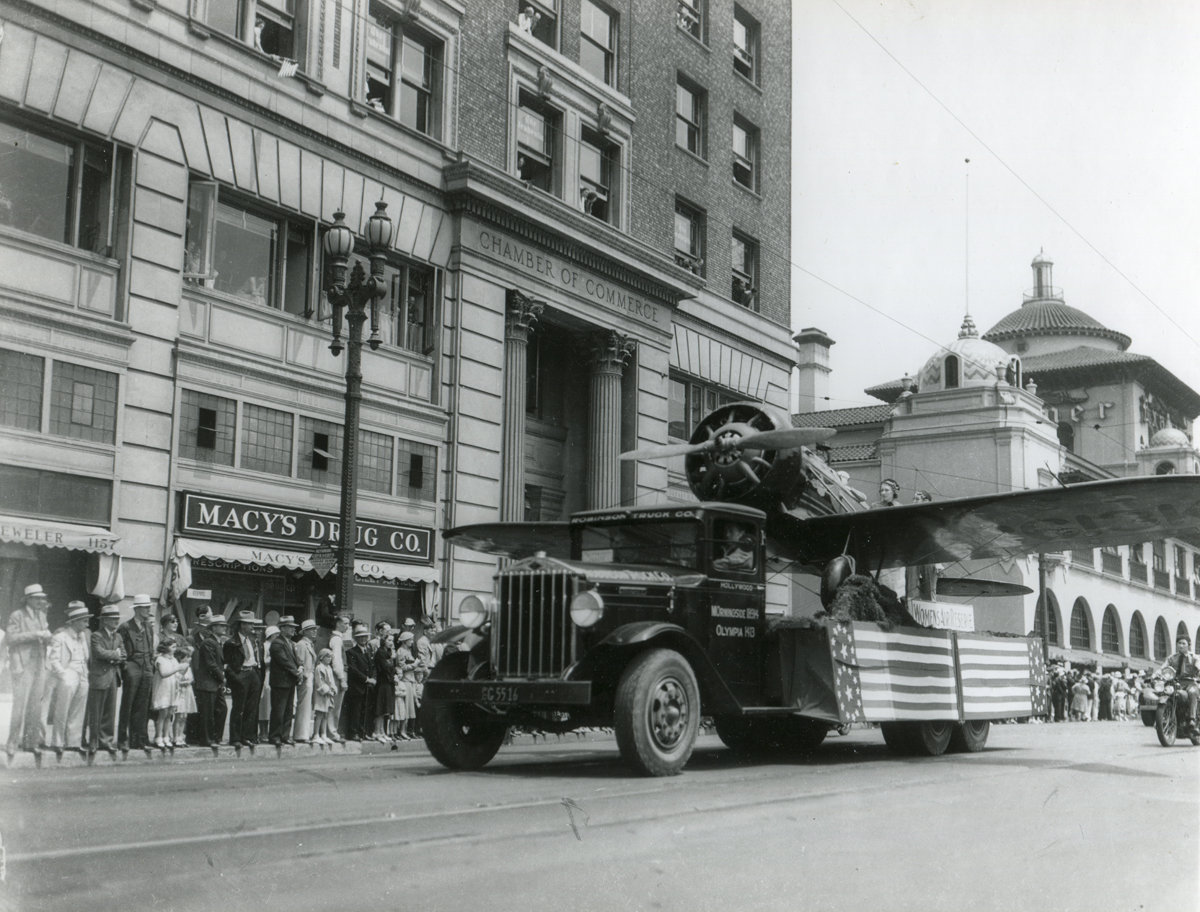
Last Friday, we posted the first photos from the recently-acquired William H. Alman collection. Today we continue drawing on this small-but-amazing set of previously unpublished images with today's first photo, which shows Pancho Barnes' Travel Air Model R, better known by its media-assigned name of "Mystery Ship", sitting on display next to Glendale's Grand Central Air Terminal.

The rest of the photos are original prints that come from the Mojave Transportation Museum collection.

Pancho's Mystery Ship on parade promoting the Women's Air Reserve. If anyone
knows the date of this parade, please comment below!
In the late 1920s, Walter Beech's Travel Air Co. of Wichita, Kansas was the world's largest aircraft manufacturer, and a powerhouse of aviation innovation, and produced a number of record-breaking and race-winning aircraft. In that era, records and trophies were one of the principal ways that aircraft companies promoted their products. On top of that, it was also an era when the US Army sent their best pilots to compete against civilians as contestants in various air races; typically, the Army would stay ahead of the civilians by using fighters with boosted engines, so they were typically the ones to beat.

Throughout the design and construction process, the Model R was a closely-guarded secret. First, Travel Air engineers Herb Rawdon (where the "R" in Model R came from) and Walter Burnham kept the project quiet from their boss until all the design details had been worked out, only ten weeks before the start of the 1929 National Air Races. Once Beech was briefed in, he enthusiastically endorsed the effort, as it showed potential for finally beating the Army at the Nationals.

Initially, Travel Air built two of the aircraft, one (Race 31, NR614K) powered by a 400 hp Wright J6-9 radial and the second (Race 32, NR613K) powered by an in-line 6-cylinder 165 hp Chevrolair D-6 engine (The Arthur Chevrolet Aviation Motors Corp was founded by Arthur, the brother of Louis Chevrolet, who stated the Chevrolet Motor Company, later part of GM). While these were under construction, a blanket of secrecy covered the factory, even to the extent that the building's windows were painted black. As a result, the very curious media (remember, air racing was a popular main-stream sport back then) dubbed the aircraft Travel Air's "Mystery Ships".

Once the aircaft were flown to Cleveland for the races, they were quickly tarped and reporters kept away. In the Thompson Trophy race, Doug Davis in #31 blew away the competition, the first time a civilian aircraft had won (mone on this in next week's post). Meanwhile Race #32 was also a winner at the 1929 Nationals, taking top place in the Experimental Class at 113.38 mph with Doug Davis again at the controls. After the races, the experimental Chevolair engine was removed and returned to the manufacturer, while the airframe was shipped back to Wichita, where it was modified to accommodate a Wright J6. It was then sold to Pancho Barnes.

Pancho used 613K to set a number of speed records, but the most famous of them was when she flew the aircraft over a closed-course at Van Nuys and shattered Women's speed record, previously held by Amelia Earhart, with a blazing 196.19 mph on August 5, 1930.

When her fortunes fell, Pancho sold 613K to Paul Mantz, who first used it in movie work, and then when it was no longer airworthy, displayed it at his Movieland of the Air museum. After Matnz' death, the plane was put up for auction, and when Pancho herself showed up to try to buy it back, she carried such respect from the aviation community that no one else was willing to bid against her. The Mystery Ship sat for years at Barnes Aviation's Lancaster CA hangar, slowly undergowing a restoration by Pancho's son Bill. When he was killed in a P-51 crash, the aircraft was again sold, this time to a collector in the UK, where for quite a while it once again became cloaked in secrecy while undergoing a pains-taking restoration, only recently reappearing, thanks to the efforts of Nick Spark, who produced the bio-pic The Legend of Pancho Barnes and the Happy Bottom Riding Club. An article on how he found the plane, along with some recent photos of it, can be found here.

A nice detailed history of the Mystery Ships can be found here.