|
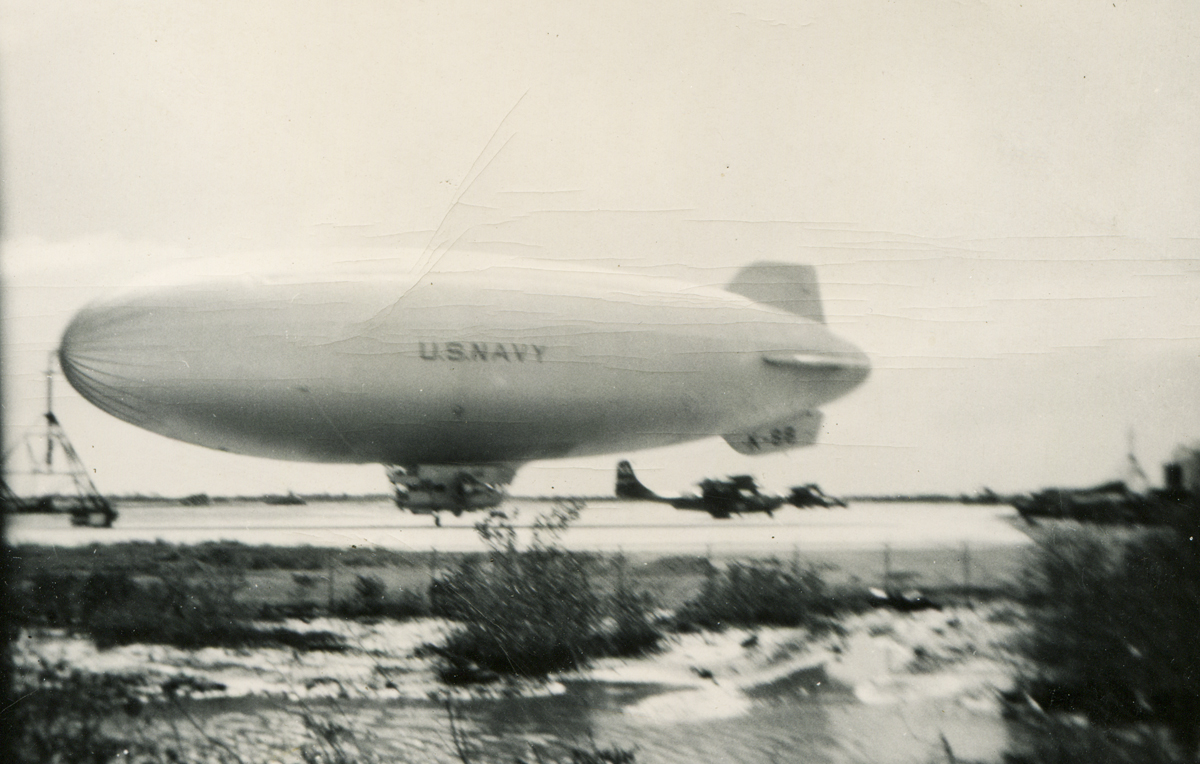
K-88 dwarfs several PBY Catalina flying boats on the ramp. The photo gives no indication of location, although Lakehurst New Jersey is a strong possibility. |
"Hey, it's the Goodyear Blimp!" is a common refrain as folks drive down the 405 in the LA area. Emphasis here on "the", as if a Goodyear blimp is a uniqueness. Once upon a time, it wasn't. In fact, during World War II, the Goodyear Aircraft Company built several hundred blimps for the Navy, which operated numerous squadrons of the non-rigid airships.
The blimps were built in several "classes", with the "K" class being the most numerous. The full Navy designation for these airships was "ZPK" (Z=lighter-than-air, P=patrol and K=class; followed by the individual ship's number). The K-class ships were based on Goodyear's L-class, which was their standard passenger and advertising model, and a total of 134 K-class blimps were built between 1938 and 1943.
The blimp shown in this week's featured photograph is K-88, which was part of the last batch of the class, ordered in mid-1943. Like its sisters, it was equipped for both day and night patrol flying, and had an ASG-type radar with a 90 nm range, as well as magnetic anomaly detection equipment. Their primary mission was anti-submarine warfare, a role in which the ship's 24-hour endurance helped greatly; the blimps were used in both the Pacific and the Atlantic, as well as the Mediterranean, for protection of shipping convoys against German U-boats. They were also often used in search-and-rescue missions, as well.
K-88 was assigned to Blimp Squadron ZP-41 in South America. Originally established as ZP-52 on June 15, 1943 at NAS Lakehurst, its designation was changed to ZP-41 a month later, and in September, its first airship, K-84, ferried to Fortaleza, Brazil, becoming the first non-rigid airship to cross the equator. In October, 1943, K-88 and K-90 both were sent to join ZP-41. In January 1944, ZP-41 moved its headquarters to San Luiz, Brazil, and that year, four more blimps joined the squadron.
After the war, plans were originally to transfer the airships to Brazilian ownership, but Brazil's cancellation of the LTA agreement precluded that. By November, 1945, the squadron had only one airship, K-52, so it is not clear when K-88 left. During the squadron's time in Brazil, they escorted a total of 5,608 ships, and did not have a single contact with an enemy submarine, and none of the ships escorted were attacked or sunk. The squadron was very active, however, in searches and rescues, both at sea and in the South American jungles.
 |
K-88's gondola, upsided down and without most of its skin,
while stored outside of the RAF Millom Museum, awaiting
restoration. (Photo by Peter Clarke, used with his kind
permission.) |
What happened to K-88 after it left Brazil is unclear at this point. Somehow, it ended up in the UK, either before or after its decommissioning from the Navy. The control car (aka gondola) as well as the engine pods have survived, loaned by the Navy to the Airship Heritage Trust and in turn on loan to the RAF Millom Aviation and Military Museum in Haverigg, UK (right; more
photos of it are here, just scroll about 3/4 of the way down the page). Unfortunately, that museum closed in 2010 due to financial issues. Initially, K-88 was due to be sold at auction, but was withdrawn because of ownership issues, since the U.S. Navy typically asserts ownership forever; as of March 2011, K-88 was still at the Millom site. There is some talk that the gondola has or will be moved somewhere else in Europe for restoration and display, but further disposition of K-88 is unknown, and anyone with knowledge is invited to comment below.