I'm going to break with tradition this week, and instead of featuring vintage photos in this special mid-week post, I'm sharing some photos of vintage aircraft that appeared at this past weekend's Flabob Flying Circus in Riverside, California. For those not familiar with it, the annual event at Flabob Airport is a magnet for antique and classic airplanes, and the relaxed atmosphere there allows fly-in spectators to mingle with planes and pilots the way airshows used to be. If you're a fan of classic planes, make sure to add this to your calendar next year. Since there was no judging or prizes for the best aircraft on display, I thought I'd offer up the official Vintage Air
top-ten list (meaning my personal faves!).
In first place was this knock-your-socks-off, absolutely gorgeous art-deco paint scheme on a beautifully restored Travel Air D-4D owned by Richard Zeiler. Named
Sky Siren, the 1929 beauty was restored by AeroCraftsman and painted by Flabob fabric and paint guru Nando Mendoza.

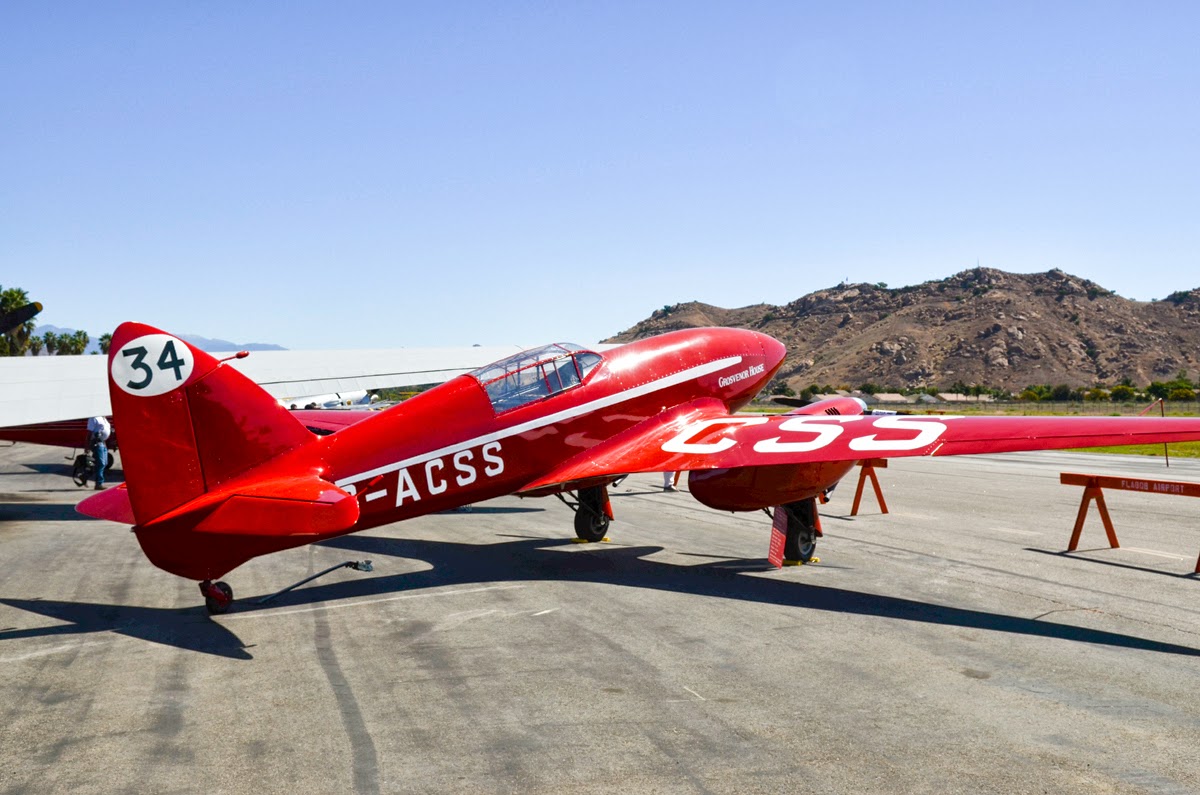
Second place goes to a plane that is well-known to Flabob visitors, the replica DeHavilland DH.88 Comet
Grosvenor House. Built by the late Bill Turner for Tom Wathen (who owns several other Golden Age replicas, as well as the airport itself!). The original DH.88 was designed and built by DeHavilland specifically to be entered in the 11,000 mile UK-to-Australia MacRobertson Trophy race in 1934. Flying against a daunting field that included Douglas' new DC-2 and Boeing's 247.
When the race was over, the DH.88 had beaten its next closest rival, the KLM DC-2 by almost a full day, this despite having to finish the last legs with one engine throttled back due to oil pressure problems.
Third place goes to this highly modified Ryan owned by Gary Jackson. Originally an Army PT-22 (c/n 1391, AAF s/n 41-15361), it was modified by John Gokchoff's Component Air at Santa Paula with the installation of a Fairchild Ranger 6-410B engine which approximates the original Menasco engines used in the ST-A sport trainers that Ryan first built.

In fourth place is this super-clean 1930 model Travel Air 4000, owned by San Diego dentist Stuart "Cap'n Mac" MacPherson, who started his aviation career years ago flying in Richard Bach's Great American Flying Circus (hence N4321's current colors).

Fifth place (and a fair amount of curiosity) goes to this Curtiss "XF9-1" replica-of-sorts. Approximating the Curtiss XF9C/F9C Sparrowhawk, the detail that's gone into this beauty is astounding.
The aircraft's FAA registration records lists this as a John Pike-built Model 1929XF, with a year of manufacture of 2010.

In sixth place is this utterly gleaming 1946 Beech D18S, owned by Rick Loomis. As much as I'd love to own a Twin Beech, I'd hate to have to polish this one!
Seventh goes to this purple A75N1 Stearman (purple, unfortunately, doesn't "translate" well in digital photography) that flew down from Washington for the event.

In 8th place, with more gleaming aluminum is Lee Maxson's 1951 Cessna 195, which flew in from Chandler, AZ.
Ninth goes to the replica 1905 Wright Flyer which is still being built at Flabob, but which was far enough along to taxi down the crowd line. My neck hurts just thinking about trying to fly in that position.
And tenth, out of many, many more fabulous planes on the Flabob ramp, is this WACO UPF-7 from Gilbert, AZ.
Finally, we were saddened to see this beautiful 1937 Rose Parrakeet suffer a rather nasty groundloop on landing, but thankfully the pilot was able to walk away. It is seen here being righted, though one cringes at the thought of the stresses on that crankshaft! Hopefully, repairs will be forthcoming!



 In fourth place is this super-clean 1930 model Travel Air 4000, owned by San Diego dentist Stuart "Cap'n Mac" MacPherson, who started his aviation career years ago flying in Richard Bach's Great American Flying Circus (hence N4321's current colors).
 Fifth place (and a fair amount of curiosity) goes to this Curtiss "XF9-1" replica-of-sorts. Approximating the Curtiss XF9C/F9C Sparrowhawk, the detail that's gone into this beauty is astounding.


 In 8th place, with more gleaming aluminum is Lee Maxson's 1951 Cessna 195, which flew in from Chandler, AZ.


