Back in August 2012, we featured a snapshot photo of B-29 Enola Gay, and today we have another of the Silverplate B-29s, The Great Artiste (serial 44-27353). This image is a contact proof that's been cut down, and was originally printed backwards (I've flipped it for use here).
The Great Artiste was named for bombardier Capt Kermit Beahan, who supposedly was quite skilled with the ladies, and with putting bombs on target. The nose art, though, was added to the plane after the Nagasaki mission. Of all the Project Silverplate B-29s, this one was the only one to directly participate in both the Hiroshima and Nagasaki missions. For the Hiroshima raid, The Great Artiste was the blast measurement instrumentation aircraft, and was flown by its normal crew, commanded by Maj. Charles Sweeney.
For the second nuke sortie, The Great Artiste was originally supposed to carry the bomb, but the mission was moved up two days to avoid some forecast bad weather, and the instrumentation from the first raid couldn't be removed in time. So, Sweeney swapped planes with Capt. Fred Bock, and Bock's Car, flown by Sweeney, dropped the weapon while The Great Ariste, flown by Bock, served once again as the blast measurement instrumentation aircraft. The primary target for this mission was the Japanese city of Kokura, but poor visibility from smoke was encountered over the target, and after three target runs, with fuel running low, the mission moved to its secondary target, Nagasaki.
After the war, The Great Artiste, like the other Silverplate B-29s, were relocated to Roswell, NM, where our photo was taken in November, 1945 (there's no indication from the inscription on the back of the photo who the young man was; the photo was acquired by the Archive in Albequerque NM). In July, 1946, the plane was used during the nuclear blast tests at Bikini atoll, and on September 8, 1949 it was used for a polar navigation training flight to the North Pole. On the return trip, the B-29 developed engine problems and a landing was attempted at Goose Bay, Labrador. The plane ran off the runway and was too heavily damaged to be salvaged, and was scrapped on-site a year later.
Sunday, October 19, 2014
Friday, October 10, 2014
Batcat: Secret Connie in Camo
Today's photo is a large, rather faded color print of Lockheed EC-121R Constellation, 67-21486 (serial 1049A-4478), also known by its program name "Batcat", which was assigned to the 553rd Reconnaissance Wing.
With the combined cover of jungle, darkness of night, bad weather and traveling through neutral Laos, the North Vietnamese truck convoys traversing the Ho Chi Minh trail and penetrating into South Vietnam were nearly impossible to detect by the Americans. To overcome this obstacle, the highly classified IGLOO WHITE program, initially known as MUSCLE SHOALS and also known as "MacNamarra's Electronic Fence", was developed in 1967.
The idea was to create a long electronic barrier against NVA infiltration into the south. Long lines of small sensors (which looked and acted like oversized lawn darts) were dropped by OP-2E Neptunes and specially-equipped F-4 Phantoms, down through the jungle canopy, where they then stuck into the earth. There were a number of different types of sensors, from acoustic microphones to radio receivers to units that picked up the seismic signatures of trucks moving over the dirt roads. High overhead, an EC-121R Batcat from the 553rd would be orbiting, picking up the return signals from the sensors, and forwarding them on to the Infiltration Surveillance Center, operated by Task Force Alpha based at Nakhon Phanom Air Base in Thailand. Information gleened from this surveillance network would then be used to target strike aircraft.
The 553rd RW was stood up in 1967 to support IGLOO WHITE and was based at Korat AB, Thailand, and operated all 30 of the EC-121R BATCATS. The EC-121Rs were converted from Navy WV-2/EC-121K and EC-121P aircraft, both from in-service aircraft and planes repurposed on the assembly line (the airframe in our photo was originally a WV-2, BuNo 143204).
A Batcat mission flew with a crew of 17-19 and typically lasted 18 hours, which including 8-11 hours in orbit on station. There were 11 different orbits, all color-coded, and ranging from the Gulf of Tonkin to over Laos and Cambodia.
With the end of the winding down of the IGLOO WHITE program, the EC-121s were replaced by the optionally-manned, Beech 36-based UC-22 single-engine aircraft. Batcat 67-21486 was evidently transferred to the 388th Tactical Fighter Wing, also at Korat, for a short time before being sent to Davis-Monthan in Tucson (where our photo was taken), Arizona on 17 December 1970. The airframe was declared surplus on 18 May 1971 and was finally scrapped in May 1973.
Tip o' the hat to Brother Eric for giving me the photo!
Some pertinent links:
With the combined cover of jungle, darkness of night, bad weather and traveling through neutral Laos, the North Vietnamese truck convoys traversing the Ho Chi Minh trail and penetrating into South Vietnam were nearly impossible to detect by the Americans. To overcome this obstacle, the highly classified IGLOO WHITE program, initially known as MUSCLE SHOALS and also known as "MacNamarra's Electronic Fence", was developed in 1967.
The idea was to create a long electronic barrier against NVA infiltration into the south. Long lines of small sensors (which looked and acted like oversized lawn darts) were dropped by OP-2E Neptunes and specially-equipped F-4 Phantoms, down through the jungle canopy, where they then stuck into the earth. There were a number of different types of sensors, from acoustic microphones to radio receivers to units that picked up the seismic signatures of trucks moving over the dirt roads. High overhead, an EC-121R Batcat from the 553rd would be orbiting, picking up the return signals from the sensors, and forwarding them on to the Infiltration Surveillance Center, operated by Task Force Alpha based at Nakhon Phanom Air Base in Thailand. Information gleened from this surveillance network would then be used to target strike aircraft.
The 553rd RW was stood up in 1967 to support IGLOO WHITE and was based at Korat AB, Thailand, and operated all 30 of the EC-121R BATCATS. The EC-121Rs were converted from Navy WV-2/EC-121K and EC-121P aircraft, both from in-service aircraft and planes repurposed on the assembly line (the airframe in our photo was originally a WV-2, BuNo 143204).
A Batcat mission flew with a crew of 17-19 and typically lasted 18 hours, which including 8-11 hours in orbit on station. There were 11 different orbits, all color-coded, and ranging from the Gulf of Tonkin to over Laos and Cambodia.
With the end of the winding down of the IGLOO WHITE program, the EC-121s were replaced by the optionally-manned, Beech 36-based UC-22 single-engine aircraft. Batcat 67-21486 was evidently transferred to the 388th Tactical Fighter Wing, also at Korat, for a short time before being sent to Davis-Monthan in Tucson (where our photo was taken), Arizona on 17 December 1970. The airframe was declared surplus on 18 May 1971 and was finally scrapped in May 1973.
Tip o' the hat to Brother Eric for giving me the photo!
Some pertinent links:
Monday, October 6, 2014
Fits Like a Glove
Greetings, fellow aviation historians, the Blog is finally returning to (somewhat) active duty! For now, my posts won't be quite as frequent as they once were, but we're back up and running. And as you might expect, the first post back is something of a mystery....
This photo is an original Douglas Aircraft print (stamp on the back says it's from the El Segundo plant), and there's a hand-written notation that reads "Laminar Flow Airfoil Glove". The plane shown, Northrop A-17A serial 35-122, at some point was turned over to NACA for a laminar flow reseearch program, which was operated out of Langley.
Unfortunately, I could find very little information about the test program (and no other photos of the plane in this configuration), and there are only a few snipets of information about it on the web, one of which mentions that the small added propellers were intended to add airflow over the wing. The primary source for information on NACA's history of laminar flow research is the paper A History of Suction-Type Laminar-Flow Control with Emphasis on Flight Research. Written by pioneering researcher Albert Braslow (who has since, sadly, passed away), this paper makes no mention of tests using the A-17A. The paper, on page 3, implies that the first laminar-flow flight tests took place in 1941 and utilized a surplus B-18 bomber. Either Braslow was unaware of the use of the A-17A (improbable, in my view), or this particular part of the larger research effort yielded little or no data of note. Joe Baugher's database indicates that 35-122 was returned to the Army in August of 1943.
If anyone has additional information on the modifications, when the test program took place, and any data that resulted from it, I would very much like to hear from you!
This photo is an original Douglas Aircraft print (stamp on the back says it's from the El Segundo plant), and there's a hand-written notation that reads "Laminar Flow Airfoil Glove". The plane shown, Northrop A-17A serial 35-122, at some point was turned over to NACA for a laminar flow reseearch program, which was operated out of Langley.
Unfortunately, I could find very little information about the test program (and no other photos of the plane in this configuration), and there are only a few snipets of information about it on the web, one of which mentions that the small added propellers were intended to add airflow over the wing. The primary source for information on NACA's history of laminar flow research is the paper A History of Suction-Type Laminar-Flow Control with Emphasis on Flight Research. Written by pioneering researcher Albert Braslow (who has since, sadly, passed away), this paper makes no mention of tests using the A-17A. The paper, on page 3, implies that the first laminar-flow flight tests took place in 1941 and utilized a surplus B-18 bomber. Either Braslow was unaware of the use of the A-17A (improbable, in my view), or this particular part of the larger research effort yielded little or no data of note. Joe Baugher's database indicates that 35-122 was returned to the Army in August of 1943.
If anyone has additional information on the modifications, when the test program took place, and any data that resulted from it, I would very much like to hear from you!
Friday, October 11, 2013
Great Lakes in the Lake
![]() |
| Compare with the logo on the left. |
The company was established in an old Martin plant in Cleveland, Ohio by president Col. Benjamin Castle. According to Aerofiles, the prototype, NC851K was powered by a pair of 115-hp Cirrus Hermes inline engines, and was severely underpowered and crashed on takeoff, while be flown by Holden C. Richardson, who was the Navy's first engineering test pilot. His presence suggests that Great Lakes was developing the 4-A-1 with hopes of marketing it to the Navy.To solve the problem, the next aircraft, NC850K (the subject of our two photos), was equipped with two Wright J-6 Whirlwinds; Aerofiles describes these as 300-hp engines, but that would make them the 7-cylinder R-760 or 9-cylinder R-975, and these are clearly only five-cylider engines, which would make them R-540s, in the 165-hp to 175-hp range. So either what is shown in our photos is an interim re-engining, or the 300-hp claim is overstated.
The original company was a victim of the Great Depression, like so many other small aircraft manufacturers. While the 4-A-1 amphibian, for what ever reason, was not built in quantity, Great Lakes built 264 Sport Trainers during the short time they were in business, and subsequent companies using the same name have continued to build more.
Readers with additional information on the 4-A-1 are invited to comment below!

Friday, October 4, 2013
Mamer's Famous Trimotor
![]() |
| I'm not sure which town this photo was taken in, but something special must have been going on, based on all the cars lined up! |
This Ford has one of the most colorful histories of any surviving Trimotor, and in January 2009 was sold at a highly publicized auction to auto collector Ron Pratte and his Collectible Aircraft LLC for $1.1 million, and it is now kept in Chandler AZ. (The auction company's website has a lot of recent photos of NC9612, and is well worth checking out. Incidently, at the same auction, Pratte bought Ford Thunderbird #1 for a cool $600K)
Nick Mamer had been a WWI pilot and served with distinction, downing three German Fokkers at Dun sut Meuse; during the battle of Argonne, he himself was shot down, surviving the inflight fire and crash due to his skillful airmanship. The French awarded him the Croix de Guerre for his service. After the war, Lt Mamer continued flying and went on to barnstorm around the Pacific Northwest. He tried his hand at air racing, and took third in the 1927 New York-Spokane Air Derby. He then started the Mamer Flying Service, providing flight instruction and charter service as well as forest fire spotting for the Forest Service. Mamer gained a bit of fame during August 1929 by flying, along with Art Walker, non-stop for five days, covering more than 7,200 miles in a Buhl while periodically being aerially refueled.
![]() |
| MAT logo from this website. |
When Northwest received a CAM route from the Twin Cities to Billings, MAT ceased offering service east of Spokane, and soon after stopped serving Portland. When Northwest started serving Spokane in 1933, Nick gave up on MAT, sold its assets to Northwest, and hired on as a pilot with them. On January 10, 1938, Nick Mamer was flying a Northwest Lockheed Model 14 Super Electra when it crashed after structural failure of the tail due to flutter, killing all aboard.
Meanwhile, in 1936, after MAT went out of business, NC9612 was passed from owner to owner for several years until it was bought in August 1940 by Charles Knox and Robert Tyce, who together owned K-T Flying Service, based in Honolulu, Hawaii. The Trimotor was at Pearl Harbor during the surprise Japanese attack, and though it was shot at, the venerable plane came through with only minor damage from a few bullet holes, which were quickly repaired. In 1945, it was shipped back to the mainland and put into storage until 1949.
With the 20th anniversary of TWA, the carrier leased NC9612 and painted it in TWA and TAT markings and sent it on a cross-country promotional tour, resulting in thousands of people shooting snapshots of the famous Trimotor. The celebrations over, the plane was converted in 1952 into an agricultural sprayer, then in 1957, the famed Johnson Flying Service of Missoula MT turned the plane into a fire-fighting air tanker, and it spent the next decade traveling across the country from fire to fire.
With newer and more capable air tankers available, the time of the Trimotor was over, and in 1969 it was purchased by Korean War ace Dolph Overton III, restored to pristine condition as part of Overton's Wings and Wheels collection, and was for a time put on display at the Virginia Air Museum.
The Barrett-Jackson auction listing for the aircraft includes this description of the restoration effort: "This was a no concession, no compromise restoration in which the airframe was reworked, a new interior installed and the exterior completely re-skinned, with most work being performed under the supervision of Master Restorer Bob Woods of Woods Aviation in Goldsboro, NC. The wings were reworked and re-skinned by expert craftsman Maurice Hovious of Hov-Aire in Vicksburg, Michigan. The landing gear, including the unique Johnson bar braking system, is complete and original. The original straight-laced wire wheels have tires that were re-sculpted to replicate the correct profile and tread pattern of the period. The wood paneling of the interior has been skillfully re-created. There are no modern avionics or communications gear - just what came with the plane when it was delivered from the Ford factory in January of 1929. Exhaustive efforts were made to ensure originality in every detail with assistance from Tim O'Callaghan of the Henry Ford Museum and American Aircraft Historian Bill Larkins, author of The Ford Tri-Motor book."
On the plane's last flight as part of the Overton collection, it was flown to the auction site by legendary pilot Jimmy Leeward, who was on the podium as the gavel fell and the auctioneer declared the plane "sold".
An extensive collection of photos of NC9612, both modern and vintage, can be found here.
As the plane was prepared for auction by the Overton Family Trust, this homepage for the plane was set up.
The Barrett-Jackson auction listing for the aircraft includes this description of the restoration effort: "This was a no concession, no compromise restoration in which the airframe was reworked, a new interior installed and the exterior completely re-skinned, with most work being performed under the supervision of Master Restorer Bob Woods of Woods Aviation in Goldsboro, NC. The wings were reworked and re-skinned by expert craftsman Maurice Hovious of Hov-Aire in Vicksburg, Michigan. The landing gear, including the unique Johnson bar braking system, is complete and original. The original straight-laced wire wheels have tires that were re-sculpted to replicate the correct profile and tread pattern of the period. The wood paneling of the interior has been skillfully re-created. There are no modern avionics or communications gear - just what came with the plane when it was delivered from the Ford factory in January of 1929. Exhaustive efforts were made to ensure originality in every detail with assistance from Tim O'Callaghan of the Henry Ford Museum and American Aircraft Historian Bill Larkins, author of The Ford Tri-Motor book."
On the plane's last flight as part of the Overton collection, it was flown to the auction site by legendary pilot Jimmy Leeward, who was on the podium as the gavel fell and the auctioneer declared the plane "sold".
An extensive collection of photos of NC9612, both modern and vintage, can be found here.
As the plane was prepared for auction by the Overton Family Trust, this homepage for the plane was set up.
Tuesday, October 1, 2013
Top 10 from the 2013 Flabob Flying Circus
I'm going to break with tradition this week, and instead of featuring vintage photos in this special mid-week post, I'm sharing some photos of vintage aircraft that appeared at this past weekend's Flabob Flying Circus in Riverside, California. For those not familiar with it, the annual event at Flabob Airport is a magnet for antique and classic airplanes, and the relaxed atmosphere there allows fly-in spectators to mingle with planes and pilots the way airshows used to be. If you're a fan of classic planes, make sure to add this to your calendar next year. Since there was no judging or prizes for the best aircraft on display, I thought I'd offer up the official Vintage Air top-ten list (meaning my personal faves!).
In first place was this knock-your-socks-off, absolutely gorgeous art-deco paint scheme on a beautifully restored Travel Air D-4D owned by Richard Zeiler. Named Sky Siren, the 1929 beauty was restored by AeroCraftsman and painted by Flabob fabric and paint guru Nando Mendoza.

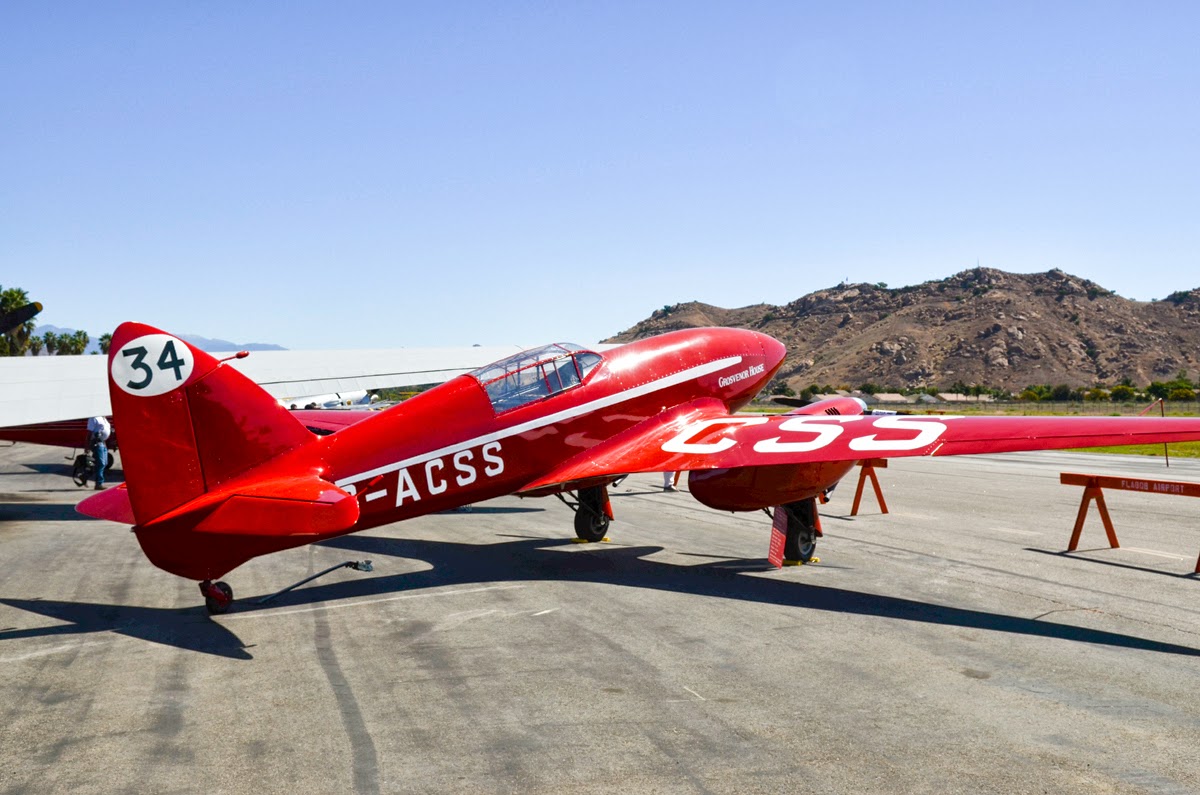
Second place goes to a plane that is well-known to Flabob visitors, the replica DeHavilland DH.88 Comet Grosvenor House. Built by the late Bill Turner for Tom Wathen (who owns several other Golden Age replicas, as well as the airport itself!). The original DH.88 was designed and built by DeHavilland specifically to be entered in the 11,000 mile UK-to-Australia MacRobertson Trophy race in 1934. Flying against a daunting field that included Douglas' new DC-2 and Boeing's 247.
When the race was over, the DH.88 had beaten its next closest rival, the KLM DC-2 by almost a full day, this despite having to finish the last legs with one engine throttled back due to oil pressure problems.
Third place goes to this highly modified Ryan owned by Gary Jackson. Originally an Army PT-22 (c/n 1391, AAF s/n 41-15361), it was modified by John Gokchoff's Component Air at Santa Paula with the installation of a Fairchild Ranger 6-410B engine which approximates the original Menasco engines used in the ST-A sport trainers that Ryan first built.
In fourth place is this super-clean 1930 model Travel Air 4000, owned by San Diego dentist Stuart "Cap'n Mac" MacPherson, who started his aviation career years ago flying in Richard Bach's Great American Flying Circus (hence N4321's current colors).
Fifth place (and a fair amount of curiosity) goes to this Curtiss "XF9-1" replica-of-sorts. Approximating the Curtiss XF9C/F9C Sparrowhawk, the detail that's gone into this beauty is astounding.
The aircraft's FAA registration records lists this as a John Pike-built Model 1929XF, with a year of manufacture of 2010.

In sixth place is this utterly gleaming 1946 Beech D18S, owned by Rick Loomis. As much as I'd love to own a Twin Beech, I'd hate to have to polish this one!
Seventh goes to this purple A75N1 Stearman (purple, unfortunately, doesn't "translate" well in digital photography) that flew down from Washington for the event.
In 8th place, with more gleaming aluminum is Lee Maxson's 1951 Cessna 195, which flew in from Chandler, AZ.
Ninth goes to the replica 1905 Wright Flyer which is still being built at Flabob, but which was far enough along to taxi down the crowd line. My neck hurts just thinking about trying to fly in that position.
And tenth, out of many, many more fabulous planes on the Flabob ramp, is this WACO UPF-7 from Gilbert, AZ.
Finally, we were saddened to see this beautiful 1937 Rose Parrakeet suffer a rather nasty groundloop on landing, but thankfully the pilot was able to walk away. It is seen here being righted, though one cringes at the thought of the stresses on that crankshaft! Hopefully, repairs will be forthcoming!
In first place was this knock-your-socks-off, absolutely gorgeous art-deco paint scheme on a beautifully restored Travel Air D-4D owned by Richard Zeiler. Named Sky Siren, the 1929 beauty was restored by AeroCraftsman and painted by Flabob fabric and paint guru Nando Mendoza.

Second place goes to a plane that is well-known to Flabob visitors, the replica DeHavilland DH.88 Comet Grosvenor House. Built by the late Bill Turner for Tom Wathen (who owns several other Golden Age replicas, as well as the airport itself!). The original DH.88 was designed and built by DeHavilland specifically to be entered in the 11,000 mile UK-to-Australia MacRobertson Trophy race in 1934. Flying against a daunting field that included Douglas' new DC-2 and Boeing's 247.
When the race was over, the DH.88 had beaten its next closest rival, the KLM DC-2 by almost a full day, this despite having to finish the last legs with one engine throttled back due to oil pressure problems.
Third place goes to this highly modified Ryan owned by Gary Jackson. Originally an Army PT-22 (c/n 1391, AAF s/n 41-15361), it was modified by John Gokchoff's Component Air at Santa Paula with the installation of a Fairchild Ranger 6-410B engine which approximates the original Menasco engines used in the ST-A sport trainers that Ryan first built.
In fourth place is this super-clean 1930 model Travel Air 4000, owned by San Diego dentist Stuart "Cap'n Mac" MacPherson, who started his aviation career years ago flying in Richard Bach's Great American Flying Circus (hence N4321's current colors).
Fifth place (and a fair amount of curiosity) goes to this Curtiss "XF9-1" replica-of-sorts. Approximating the Curtiss XF9C/F9C Sparrowhawk, the detail that's gone into this beauty is astounding.The aircraft's FAA registration records lists this as a John Pike-built Model 1929XF, with a year of manufacture of 2010.

In sixth place is this utterly gleaming 1946 Beech D18S, owned by Rick Loomis. As much as I'd love to own a Twin Beech, I'd hate to have to polish this one!
Seventh goes to this purple A75N1 Stearman (purple, unfortunately, doesn't "translate" well in digital photography) that flew down from Washington for the event.
In 8th place, with more gleaming aluminum is Lee Maxson's 1951 Cessna 195, which flew in from Chandler, AZ.Ninth goes to the replica 1905 Wright Flyer which is still being built at Flabob, but which was far enough along to taxi down the crowd line. My neck hurts just thinking about trying to fly in that position.
And tenth, out of many, many more fabulous planes on the Flabob ramp, is this WACO UPF-7 from Gilbert, AZ.
Finally, we were saddened to see this beautiful 1937 Rose Parrakeet suffer a rather nasty groundloop on landing, but thankfully the pilot was able to walk away. It is seen here being righted, though one cringes at the thought of the stresses on that crankshaft! Hopefully, repairs will be forthcoming!
Friday, September 27, 2013
An American Messerschmitt
Eleven ME-262s were returned to flight status at Lechfeld, Germany and ten were ferried back (one had crashed during a test flight) to the US onboard the British carrier HMS Reaper. This group of ten were split between the US Navy and Army Air Forces, and became (unoffically, of course), America's first jet fighter squadron. A very detailed article about the unit and the men that brought these captured planes home, who collectively became known as "Watson's Whizzers", can be found here.
![]() |
| While stored at Chino in the early 1960s. |
One set of flight tests was aimed at evaluating the ME-262's capabilities against America's top operational fighter, the Lockheed P-80 Shooting Star. Messerschmitt had designed and assembled the ME-262 as a modular aircraft, so it was easy to change a plane's confirguration. For this series of evaluation flights, the American crew removed 4012's reconnaissance nose and replaced it with an aerodynamically cleaner fighter nose, sealed the gun ports, and gave the plane a new gloss paint job. On 17 May 1946, the plane was ferried to Patterson Field (at the time, the field's management had not yet been merged with nearby Wilbur Wright Field) where the testing was to be based. A total of eight flights were flown, two of which resulted in emergency landings. The engines were proving to be extremely unreliable, and after only 4 hours and 40 minutes of testing - and four engine changes! - the testing was called off in August of that year.
Despite the fact that (at least by modern flight test data acquisition standards) this was hardly enough flight time to gather an abundance of reliable flight test data, the Army concluded that the ME-262 had better accelleration and top speed, while showing about the same climb performance as compared to the P-80. The ME-262 also appeared to have a much higher critical Mach number, meaning that it had much less high-speed drag and better performance in the transonic realm.
After the AAF completed the flight testing, the aircraft was disassembled and shipped to Hughes Aircraft in Culver City for storage. There the plane was reassembled and the engines were ground-run, but the plane wasn't flown. Rumors have persisted over the years (and have been amplified on the internet) that there was a desire on the part of Howard Hughes to fine tune 4012 and enter it in a Thompson Trophy race against the AAF's P-80. The conspiracy-theory type rumors state that this effort was squashed by General Hap Arnold as part of a "cover-up" because he didn't want an old Nazi war machine showing up America's newest weapon.
However, despite the persistence of this story, there appears to be no factual basis for it, and when one looks at the details, the improbability of it all really stands out, even given the well-known animosity between Arnold and Hughes. First and foremost, if anyone could make the ME-262 fly reliably, it was Watson's Whizzers, who had access to plenty of spare parts as well as German expertise; Hughes might have had money, but he had none of this. Even with all those resources, the aspect that stands out most from the plane's testing was the terrible reliability of the Jumo 004 engines, which would have been wholly unsuited for air racing. On top of the practicality issues, the timing of it all just doesn't fit. The stories never really indicate which Thompson Trophy race the plane was to be entered in, but there were only three that were possibilities, the 1946, '47 and '48 races.
In the time leading up to the 1946 race (held from 29 August through 3 September), the plane was still in the hands of the AAF at Patterson, Hughes was in the hospital recovering from the near-fatal crash of the XF-11, and most importantly, Hap Arnold had just retired, and so was out of the picture in regards to any official coverup. By the 1948 races, the new North American F-86, which could fly circles around the P-80 (by then, F-80), had been in development flight test for a year, and so had made any grudge match a moot point; the races that year were dominated by the Navy's FJ Fury, and the P-80 didn't even appear.
That leaves the 1947 races, but Hap Arnold was still out if the picture in retirement, Hughes was neck-deep in preparations for both the H-4 (aka Spruce Goose) first flight...in fact he was so focused on this project that once made the statement that if the H-4 Hercules didn't fly, he'd up and leave the country for good. In addition, Hughes had the task of preparing for and testifying at the contentious hearings of the Senate War Investigating Committee. While 4012 was stored at Hughes' Culver City facility, it was still government property, and thus couldn't just be used for any personal racing whims that an otherwise swamped Hughes might have. So, barring some heretofore unknown hard evidence that Hughes proposed such a project, the story should be regarded as just one more Hughes-related rumor.
After a short time in storage at Hughes, it became clear to the leadership of the new USAF that our own technology was already far ahead of where the Nazis had been a few years earlier, and there was nothing to be gained in further testing of the ME-262. Thus, the aircraft was given to Cal Aero Technical Institute at the Glendale airport, where it was used as a hands-on teaching tool for student aircraft mechanics.
In about 1955, the plane was acquired by Edward Maloney for his Planes of Fame collection, and was partially restored, and statically displayed incorrectly as WkNr 111617 at the Chino museum. In about 2000, ex-Microsoft executive Paul G. Allen purchased the plane for his Flying Heritage Collection, located at Paine Field in Washington. According to some reports, it was shipped to the UK for restoration, but has since returned to the US, where it is reportedly being completed to flying condition, to be powered a pair of original Jumo engines. The aircraft has been registered with the FAA as N94503, with ownership being listed as Vulcan Warbirds, Inc., one of Allen's companies.
Subscribe to:
Posts (Atom)